

Bambu Lab looks to be moving into another new product category, because a device called the Bambu Lab S1 has been granted FCC approval, and for once we do not have to guess what the product is, since the label included in the filing identifies it as a 3D scanner.
As a short disclaimer, Bambu Lab has not announced any scanner at the time this article is written, so everything here comes from the public FCC grant for the device and from SCANTECH’s own exchange filings, rather than from anything Bambu Lab has said or shown.
What I want to do here is go through what the filing actually contains, point out the one test result that tells us more about this device than any of the images going around, and then connect all of it to the scanner partnership that Bambu Lab signed back in January. We have gone through Bambu Lab FCC filings on Domechy before with the H3C and the P3C, and the same caution applies here, because a filing only tells us that a device exists and has passed radio testing, and it does not tell us that the product is finished or that it will ever reach the market.
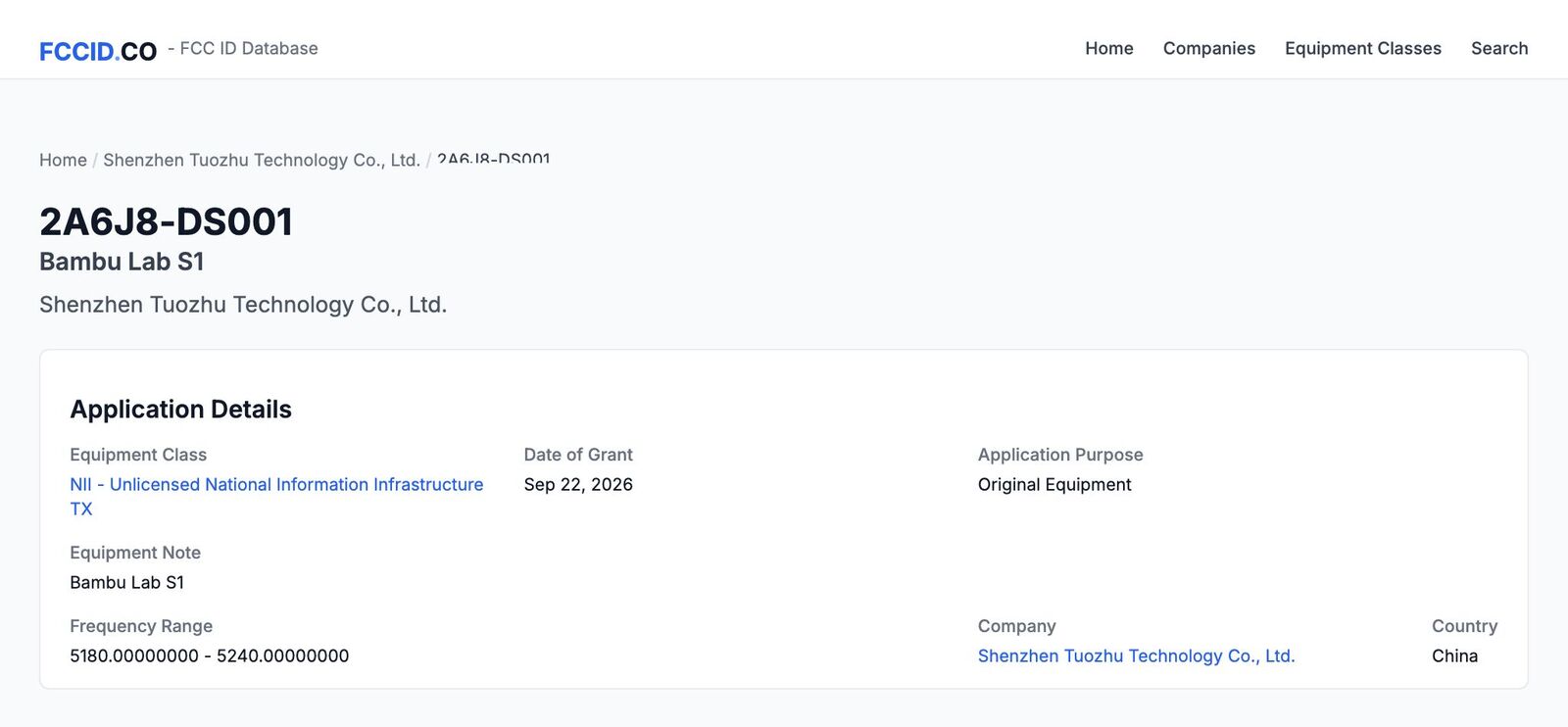
What the filing shows
| Item | Detail |
|---|---|
| FCC ID | 2A6J8-DS001 |
| Applicant | Shenzhen Tuozhu Technology Co., Ltd. |
| Product name | Bambu Lab S1 |
| Model | DS001 |
| Grant date | 22 September 2026 |
| Application purpose | Original equipment |
| Equipment class | NII, unlicensed 5 GHz transmitter |
| Frequency bands | 5.18 to 5.24 GHz at 57 mW, 5.75 to 5.83 GHz at 166 mW |
| Channel widths | 20 MHz, 40 MHz, 80 MHz |
| Extremity SAR result | 3.81 W/kg |
| Test laboratory | SGS Tongfang Technical Services |
| Label rating | 20 V at 3 A, 60 W, marked indoor use only |
| Canadian IC number | 28436-DS001 |
| US agent | Bambulab USA Inc., Austin, Texas |
Shenzhen Tuozhu Technology is the company behind Bambu Lab, and the same applicant name sits on the company’s printer filings, so there is no ambiguity about who this device belongs to. The device label included in the filing identifies the product as a 3D scanner, which is unusual in itself, because most FCC leaks leave us guessing at what the product even is.
There are two important details here that are easy to report wrongly, so we need to be careful when reading this filing. The 22 September 2026 date is the grant date, meaning the day the FCC approved the application rather than the day Bambu Lab submitted it, and applications normally go in anywhere from a few days to a few weeks before that. The grant also covers 5 GHz Wi-Fi only, so if the S1 carries 2.4 GHz Wi-Fi or Bluetooth as well, that would usually appear as a separate filing under its own ID, and nothing like that is sitting next to this one at the moment.
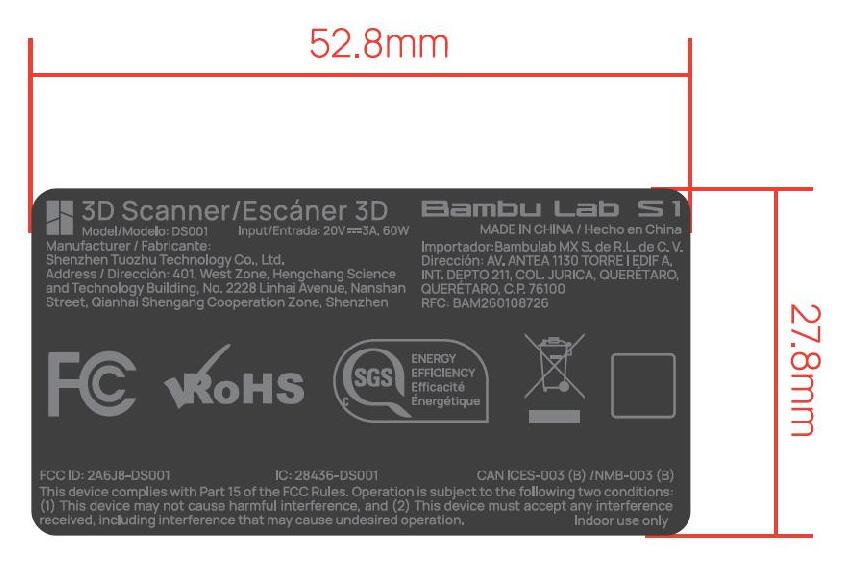
The product label itself is one of the public exhibits, and it carries more than the 3D Scanner wording, since it also lists the input rating as 20 V at 3 A for 60 W, marks the device as indoor use only, and carries the Canadian IC number 28436-DS001 alongside the FCC ID, which tells us Bambu Lab is certifying this device for Canada at the same time.
The SAR test points to a handheld device
The SAR result tells us more about this device than the frequency list does, and most of the early coverage has skipped past it on the way to the specifications.
SAR, or specific absorption rate, measures how much radio energy the body absorbs from a device while that device is transmitting, and the FCC splits equipment into two groups for this purpose, where anything whose radiating parts sit within 20 cm of the user counts as portable and goes through SAR testing under 47 CFR 2.1093, while equipment used further away is assessed on field strength instead. The S1 went down the portable route and was tested for extremity exposure, coming back at 3.81 W/kg against a limit of 4.0 W/kg averaged over 10 g of tissue, so it passes, although the margin is not especially wide.
Extremity testing covers the hands and wrists specifically, so choosing that exposure condition says Bambu Lab expects the device to be operated within arm’s reach of the user and most likely gripped while it transmits, which supports the handheld reading far better than the pictures going around, since it comes out of the compliance paperwork rather than out of someone’s interpretation of a drawing.
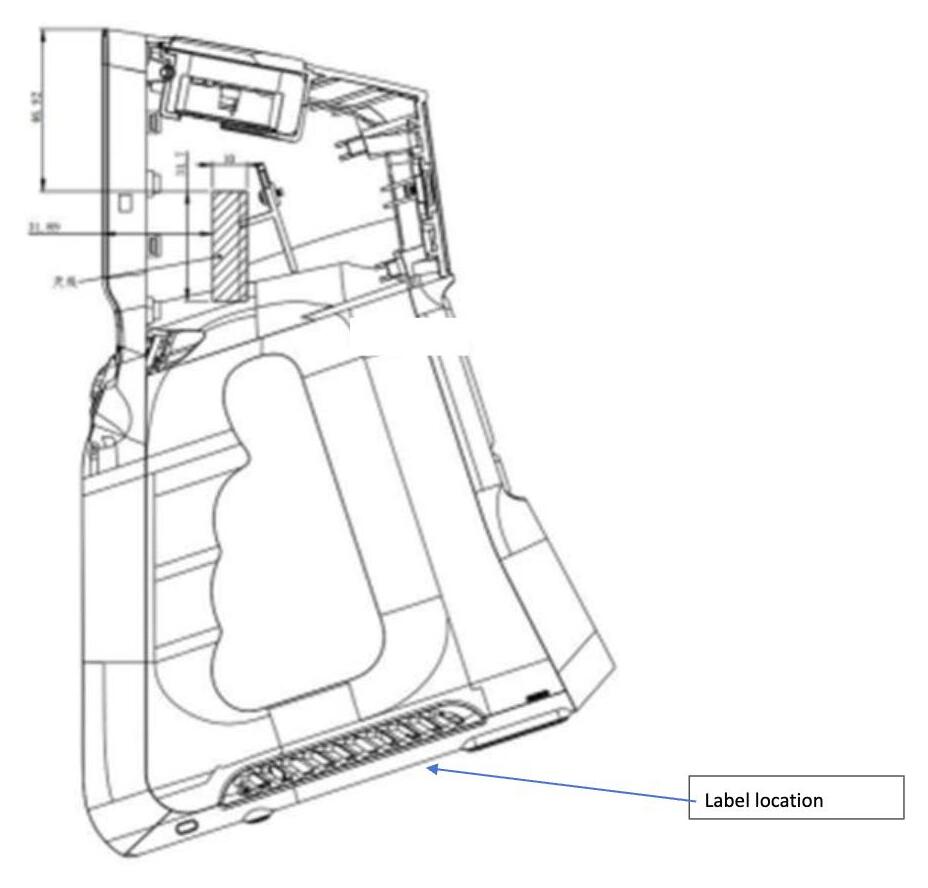
The drawing above is the second page of the same label exhibit, and it is almost certainly the source of the images going around, since the internal and external photographs in this filing are confidential while the label location page stays public. The outline is a line drawing rather than a photograph, so it shows the shape of the housing and where the grip sits without telling us anything about the finish, the screen or the sensors on the front.
What is hidden, and when it opens up
The filing splits its confidential exhibits into two groups, and each group comes with its own expiry. Schematics, block diagrams, the operational description and the software security information are all under long-term confidentiality, so those are simply not going to show up. The external photographs, internal photographs, test setup photographs and the user manual sit under short-term confidentiality of 180 days instead, which runs out around 21 March 2027.
Either Bambu Lab announces the product before that date, or the photographs and the manual become public on their own and show us most of what the company would otherwise have revealed on its own terms.
The SCANTECH partnership behind it
A Bambu Lab scanner is not really a surprise, because the groundwork for it was announced publicly at the start of this year.
On 29 January 2026, SCANTECH, a Hangzhou-based 3D scanning company listed on the Shanghai STAR Market under the code 688583, announced that it had signed a framework cooperation agreement with Shenzhen Tuozhu Technology, under which the two companies would jointly design and develop consumer-grade 3D scanners, with SCANTECH producing them and selling them to Bambu Lab.
The announcement describes a framework contract and states plainly that the total contract amount was not specified, and that the two companies had no transaction or capital relationship at all in the three years before it, which means the agreement commits both sides to work together but stops some distance short of being an order with volumes and prices attached to it.
Two later disclosures from SCANTECH fill in what has happened since. In an investor question and answer session in May 2026, the company said that the cooperation runs for five years, that senior management on both sides are personally supervising the development and the production, and that it expected the cooperation to start generating revenue during 2026. Then in August, SCANTECH’s half-year report showed research and development spending up 62.67 per cent year on year to 61.9 million yuan, which works out to 33.45 per cent of its revenue, and the company told shareholders that the resulting pressure on short-term profit was a deliberate choice made to fund its expansion from industrial-grade products into consumer-grade ones.
A scanner manufacturer putting a third of its revenue into R&D, while telling its own shareholders that profit will suffer because it is moving into the consumer market, is a much clearer signal than any progress update would be. A month after that report, a Bambu Lab device labelled as a 3D scanner cleared the FCC, and the two things sit together fairly comfortably even though the filing itself never mentions SCANTECH anywhere, which means the connection stays circumstantial no matter how neat the timeline looks.
What the filing does not tell us
The FCC grant says nothing at all about scanning technology, accuracy, resolution, colour capture, software or price, and it would be a mistake to fill those gaps with SCANTECH’s existing products, since the scanners it sells under its own 3DeVOK brand are positioned as professional-grade tools and there is no basis for assuming the S1 shares their hardware or their specifications.
There is no launch date in there either. A granted filing does tell us the radio has passed testing, which usually places a product reasonably late in its development, but manufacturers file anywhere from a few days to several months ahead of a release, so the date on the grant is not a countdown.
For those of us in Malaysia there is one more step in the way, since FCC approval only covers the United States and anything sold here needs SIRIM certification separately, so a device that has cleared the FCC has not necessarily started that process at all.
Where a scanner would fit
Bambu Lab’s real strength has never been any single printer, but the way the printers, the AMS units, Bambu Studio, Bambu Handy and MakerWorld work together without much friction between them. Scanning is the obvious gap in that chain, because turning a scan into something printable today usually means moving between separate pieces of software and doing a fair amount of mesh repair along the way.
A scanner that feeds cleanly into Bambu Studio would close that gap, and it would follow the same pattern as the R1 laser cutter that launched this week, which extends the ecosystem into a new process rather than adding another printer to the lineup. None of that appears in the filing, so it is what the category and the company’s direction suggest, and not something Bambu Lab has claimed.
What to watch for next
Any further Bambu Lab filing covering a 2.4 GHz radio or accessories tied to the same model would tell us more about how this device is meant to be used, so that is the first place to look. SCANTECH’s next quarterly disclosure is the second, because the company has told investors it expects the cooperation to start contributing revenue during 2026, and since SCANTECH’s side of the deal is producing the scanners and selling them to Bambu Lab, revenue appearing in its books would point to units being built and delivered rather than to a retail launch, which still makes the timing worth following. Failing both of those, 21 March 2027 is when the confidential photographs and the user manual are due to become public anyway.
Sources
- FCC ID 2A6J8-DS001, Bambu Lab S1 equipment authorisation
- Bambu Lab S1 discussion thread, Bambu Lab Community Forum
- Announcement on signing a framework contract for daily operations, SCANTECH via Shanghai Stock Exchange
- SCANTECH investor question and answer on the five-year Tuozhu cooperation, Eastmoney
- SCANTECH 2026 half-year results and the shift from industrial to consumer grade, Tencent News
- Bambu Lab H3C And P3C Are Coming, Domechy
Don’t miss the latest articles and guides
Get new Domechy articles, guides and free models straight to your inbox.

Harap harganya takde la tinggi sangat 🤲
aamiinnn. harapnya begitu la
yesss, ini yang kita mauuu
yeahhh. nanti dah release kita bodek Bambu Lab sponsor 3D scanner ni pulak utk hadiah monthly challenge haha