

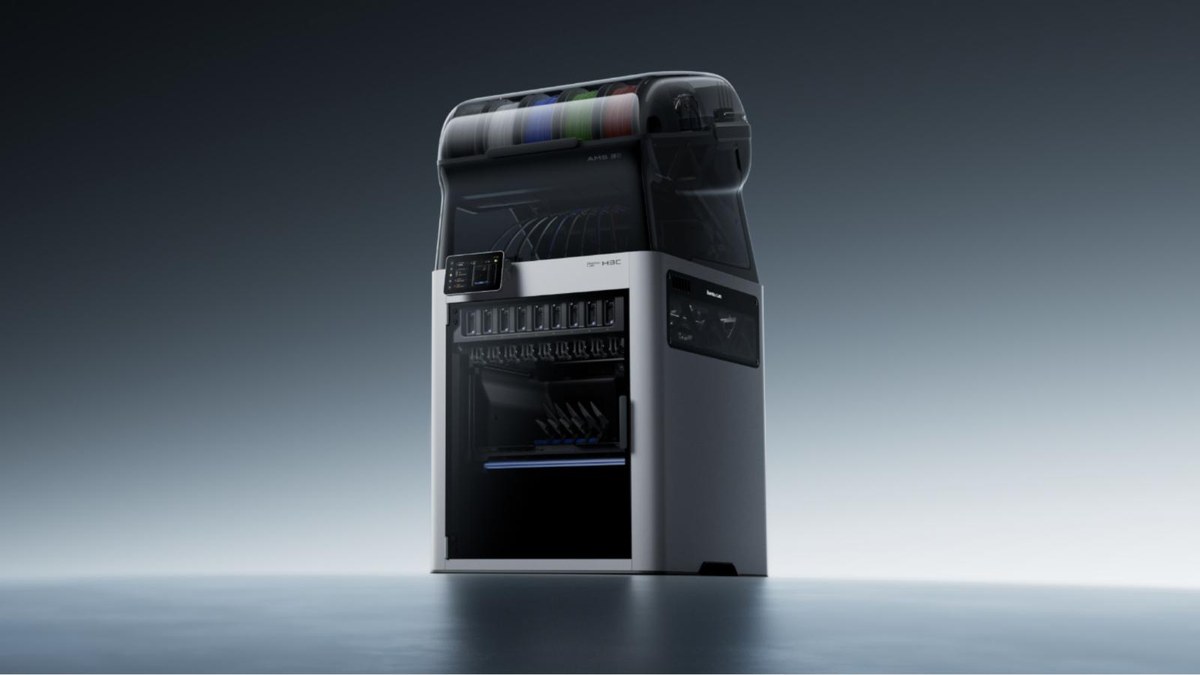
Bambu Lab has officially launched the H3C, its first toolchanger 3D printer, at US$2,499 for the H3C AMS Combo, which includes the printer, all nine tools and the new AMS 3H filament system. It went on sale on 3 November 2026 through the Bambu Lab store, at €2,499 in Europe and £2,199 in the UK.
As a short disclaimer, the H3C was announced only today, so this article is based on Bambu Lab’s launch announcement and early published reviews, not on hands-on experience with the printer.
Price and bundles
| Bundle | US price |
|---|---|
| H3C AMS Combo (printer, nine tools, AMS 3H) | US$2,499 |
| Combo with PLA Palette and TPU | US$2,589 |
| Above, plus the open Bambu Station cart | US$2,799 |
| Above, with the enclosed Bambu Station and E1 Air Purifier | US$3,049 |
There is no option to buy the H3C without the AMS 3H, since the AMS 3H sits on top of the printer and feeds all nine tools. For buyers in Malaysia, Bambu Lab has not published local pricing yet, and because the H3C has Wi-Fi, official sales here need equipment certification through SIRIM QAS under MCMC requirements.
Key specifications
| Specification | Bambu Lab H3C |
|---|---|
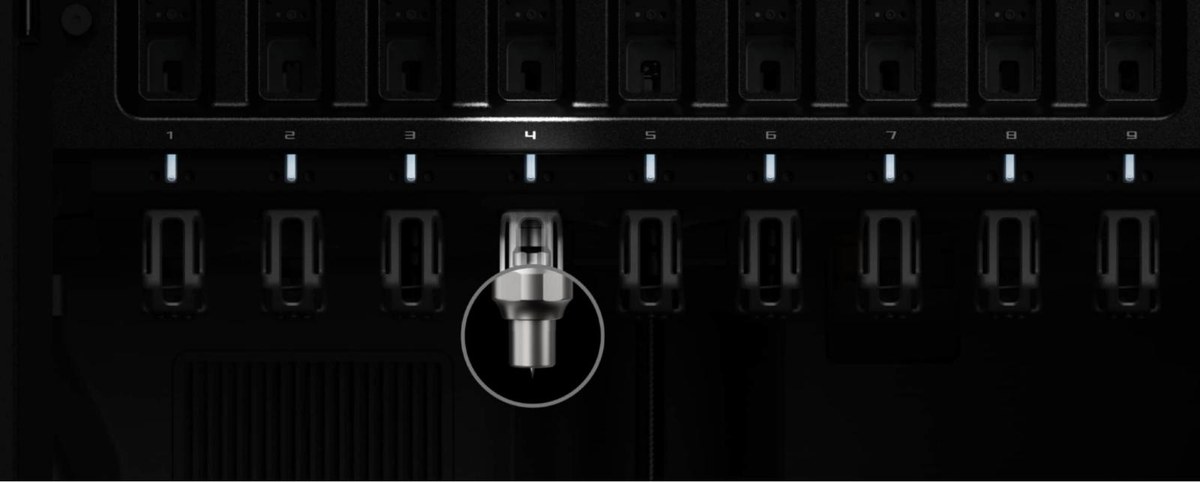
| Tools | 9, each with its own hotend, filament path and cutter |
| Tool change time | 3.4 seconds for the swap and about 6 seconds for a full material switch, according to Bambu Lab |
| Build volume | 330 × 320 × 325 mm |
| Nozzles | 0.4 mm as standard, with 0.2, 0.6 and 0.8 mm optional, all hardened steel rated HRC 55+ |
| Filament | Eight tools for 1.75 mm and one for 2.85 mm TPU |
| Maximum temperatures | Nozzle 350 °C, bed 120 °C, actively heated chamber 65 °C |
| Speed | Up to 1,400 mm/s toolhead travel and 25,000 mm/s² acceleration, with 40 mm³/s maximum flow, according to Bambu Lab |
| Weight | 36.28 kg including the AMS 3H |
Nine tools, each with its own filament path
Bambu Lab calls the system Swaptek, and each of the nine tools, which Bambu Lab calls PrintTools, carries its own hotend, filament path and built-in cutter, while the FlexFeed extruder appears to stay on the print head, which is a similar arrangement to Prusa’s INDX. Because every tool stays loaded with its own filament, a colour or material change is a swap from one tool to the next rather than an unload and reload of filament. Bambu Lab quotes 3.4 seconds for the tool swap itself and about 6 seconds for a full material switch including priming, helped by a feature it calls Active Pre-Heat, which starts heating the next tool while the current one finishes its section. The tools park in the front rack that Bambu Lab showed in its teasers, which folds up during printing to keep the build plate visible.
All nine nozzles are hardened steel rated HRC 55+, so any tool fitted with a suitable nozzle size can print carbon fibre and glass fibre filaments, and nozzle sizes from 0.2 mm to 0.8 mm can be mixed in a single print. Bambu Lab has also announced optional CutTool, DrawTool and DebossTool attachments that dock in the same rack and switch automatically, but these are sold separately, and the launch bundles only list the printing tools. We explained what the HRC 55+ figure means in our pre-reveal article on the H3C teasers.
Colour mixing with the PLA Palette
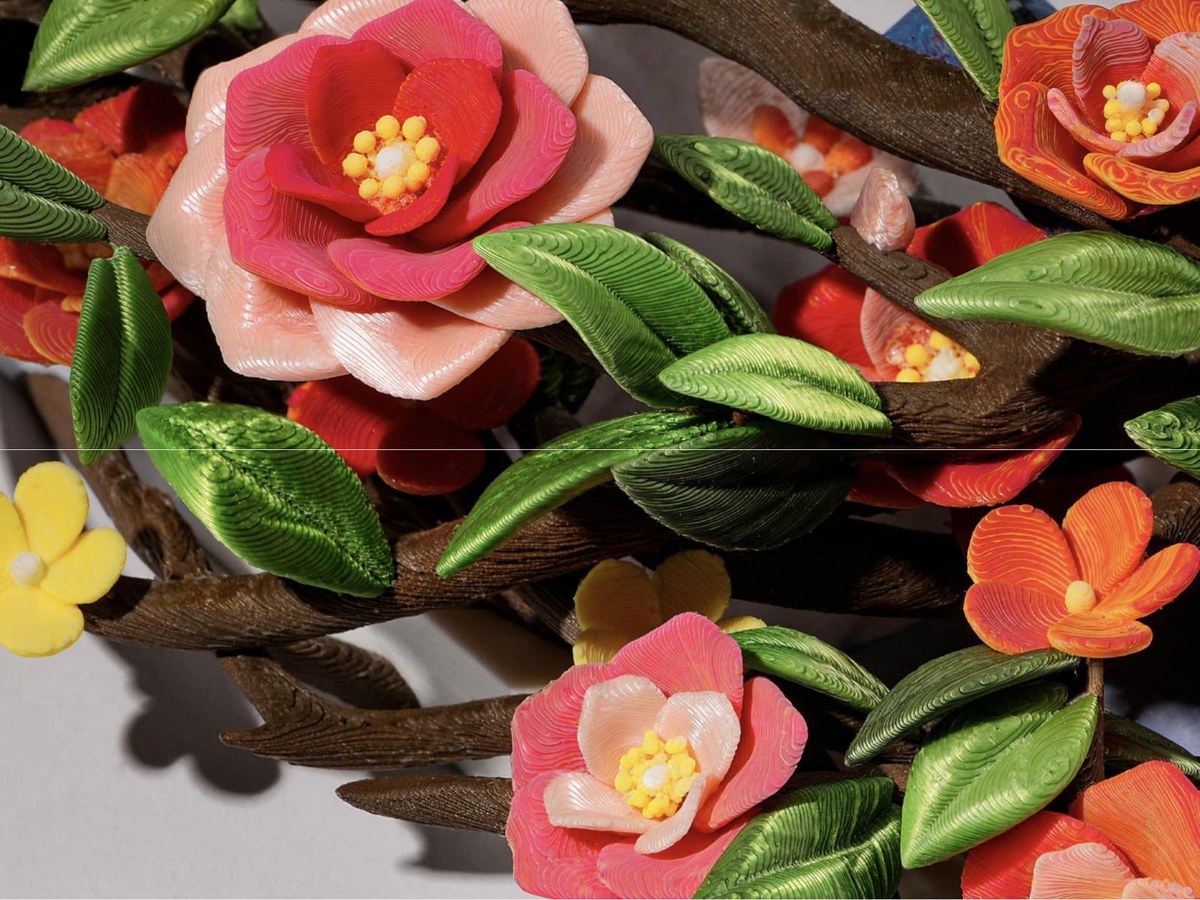
The H3C is not limited to nine solid colours. Bambu Lab’s new PLA Palette is a set of cyan, magenta, yellow and white opaque filaments plus a translucent black, and the H3C layers them to blend additional colours within a print, in a similar way to how a colour printer builds tones from a few inks. Bambu Lab says the Palette is needed for the intended results, and it is sold as an add-on or in the US$2,589 bundle. This is aimed at figurines and decorative prints with gradients and many shades, while technical multi-material prints would still use separate filaments in separate tools.
AMS 3H and 2.85 mm TPU
The AMS 3H holds nine spools in a sealed unit on top of the printer, one for each tool. Its drying section reaches 85 °C and can run while the printer is printing, although the published specifications and reviews show that it dries two spools at a time rather than all nine, so the other seven slots are sealed storage rather than active dryers. Bambu Lab says the system can be expanded to 24 materials by connecting compatible AMS units through PrintTool No. 1, so the extra spools share that one tool, and that an AMS 2 Pro or AMS HT can be added for more drying capacity.
One of the nine tools is set up for 2.85 mm filament, which Bambu Lab uses for very soft TPU down to 75A, and it says this path allows up to three times the flow of a conventional printer. The 2.85 mm filament does not go through the AMS 3H’s automatic feeding, since it is loaded through the bypass inlets on top of the unit and fed straight to the tool, which Tom’s Hardware also had to do by hand for very soft TPU in its review. Bambu Lab sells TPU 75A in 2.85 mm for the H3C.
Early reviews
Tom’s Hardware and TechRadar have both published reviews today and both gave the H3C an Editor’s Choice award, while noting that it is large, heavy and expensive. Tom’s Hardware’s tests also show that the H3C reduces waste rather than eliminating it, since it still prints a prime tower. On an eight-colour dragon model, the H3C produced 68 g of purge and prime waste against 267 g on an Anycubic Kobra 3 Max, a single-nozzle printer using two of its own multi-colour units, while on a nine-colour model it produced 152.6 g, against 111.4 g for a five-colour version on the H2C and 24 g for an eight-colour version on a Prusa INDX. These are single tests with different colour counts and settings, so they show the general picture rather than a fixed ranking, but they suggest the H3C’s prime tower is larger than the INDX’s.
How it compares with other toolchangers
| Printer | Tools | System | US price |
|---|---|---|---|
| Bambu Lab H3C AMS Combo | 9 | Toolchanger | US$2,499, with AMS 3H |
| Prusa CORE One+ INDX 8-Tool | 8 | Toolchanger | About US$2,082 assembled, or US$1,805 as a kit |
| Snapmaker U1 | 4 | Toolchanger | US$899 |
| Flashforge Creator 5 | 4 | Toolchanger | US$799, US$949 for the Pro |
| Bambu Lab H2C Combo, for reference | 6 swappable hotends plus 1 fixed | Hotend changer (Vortek) | US$2,199 |
Prices were checked on 3 November 2026, and availability, promotions and regional pricing may vary.
The closest rival is the assembled CORE One+ INDX 8-Tool, which costs about US$400 less on Prusa’s store, and for that difference the H3C adds a ninth tool, a much larger build volume of 330 × 320 × 325 mm against 248 × 205 × 270 mm, 2.85 mm TPU support and a filament system with drying. The four-tool machines are far cheaper, but they offer less than half the tools. Bambu Lab did not mention the P3C in its launch announcement, so the seven-tool P-series printer that appeared in certification photos is still unannounced, and we covered what is known in our P3C and H3C toolchanger leak article.
What we still do not know
Bambu Lab has not given a shipping date beyond the launch-day availability, local Malaysian pricing, or the price of extra tools and nozzles. The reviews also mention early firmware issues that were being fixed during testing, so long-term reliability of a nine-tool system will only become clear once more owners have it.
Sources
- Tool changer. Game changer. Bambu Lab presents H3C, PR Newswire
- Bambu Lab H3C 3D printer review, Tom’s Hardware
- Bambu Lab H3C 3D printer review, TechRadar
- Bambu Lab H3C brings a nine-tool changer to desktop 3D printing, VoxelMatters
- Bambu Lab Releases $2,499 Full-Color, Multi-Toolhead H3C 3D Printer, 3DPrint.com
- TPU 75A (2.85mm), Bambu Lab Store
- Flashforge’s Creator 5 Toolchanger Takes Aim at the Snapmaker U1, All3DP
- Prusa CORE One+ INDX 8-Tool, Prusa Research
- The Bambu Lab H3C Has Launched: Confirmed Specs vs. the Rumours, 3DBite
- Bambu Lab H3C Teasers So Far, Domechy
- Bambu Lab AMS 3H and AMS 3P FCC Filings Explained, Domechy
- Bambu Lab P3C and H3C Toolchanger Leaks, Domechy
Don’t miss the latest articles and guides
Get new Domechy articles, guides and free models straight to your inbox.

cun nih