

As a short disclaimer, the QIDI Q3D is still on pre-order and has not shipped yet, so this article is based on QIDI’s announcement and product page, not on personal experience using the printer.
QIDI launched the Q3D at Formnext 2026 in Frankfurt on 17 November, and pre-orders opened on its official store the same day. The Q3D is an enclosed CoreXY printer with two hotends in one toolhead, a main hotend rated to 350°C and a chamber that QIDI heats up to 70°C. The regular price is $599, while the pre-order price is $529, paid as a refundable $30 deposit now and a $499 balance later, which works out $70 below the regular price.
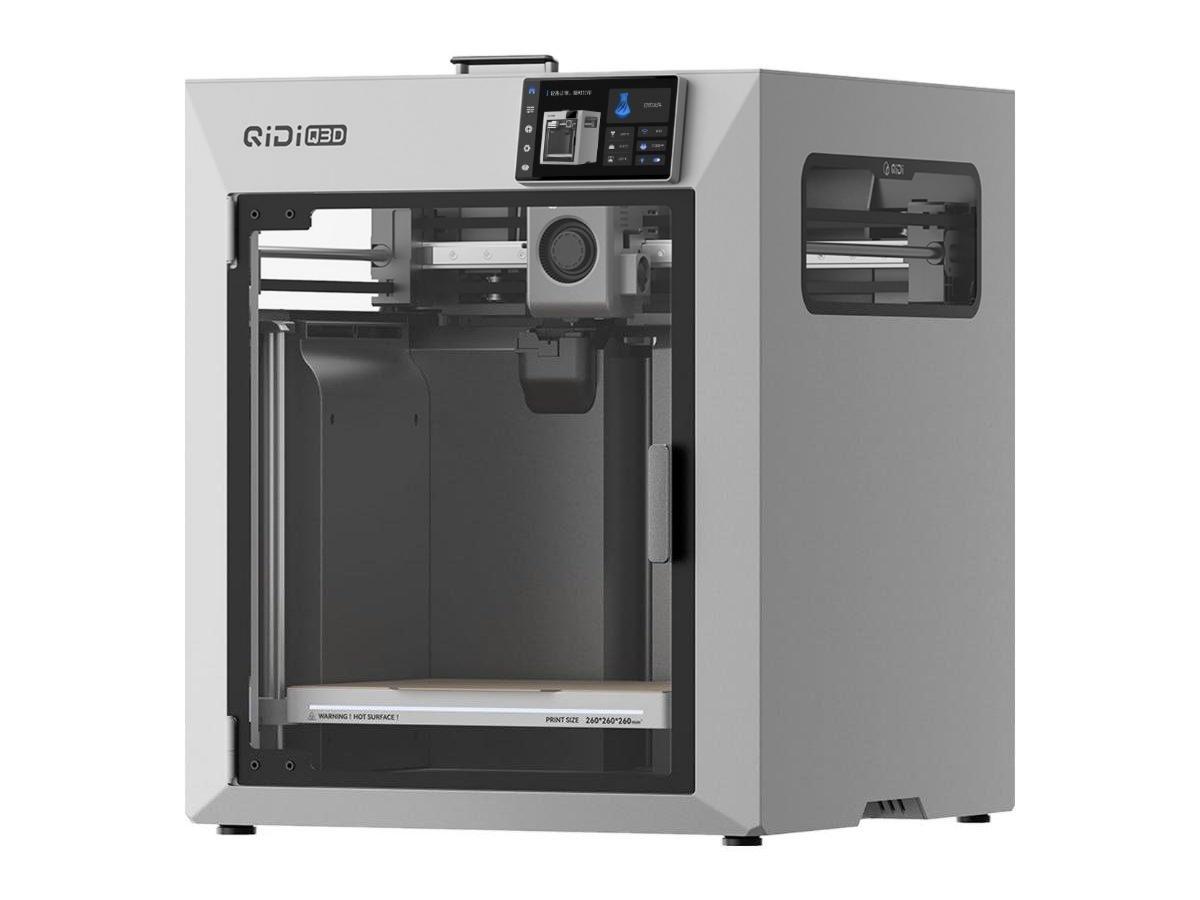
Two hotends in one toolhead
The Q3D has a main hotend and an auxiliary hotend mounted side by side on one toolhead, and each has its own nozzle, temperature and filament path. Because the two materials never share a nozzle, the printer does not need to purge one filament out before printing the other, which is where QIDI’s claims about saving time and filament come from. This is a different approach from a toolchanger, which parks complete printheads and picks them up, and from single-nozzle systems such as an AMS, which feed several filaments through the same nozzle.
QIDI describes the switching between the two nozzles as instantaneous but does not explain the mechanism or give a switching time. It also lists a maximum of 350°C for the print head without giving a separate figure for the auxiliary nozzle. According to QIDI’s FAQ, the auxiliary nozzle can print PLA, PETG, ABS, ASA, TPU 64D, PA, PC and PVA, as well as QIDI’s dedicated support filaments, so a typical use is printing the model with the main nozzle and soluble or breakaway supports with the auxiliary nozzle. QIDI recommends keeping fibre-reinforced filaments, silk PLA and TPU 64D on the main hotend for the best results. The box contents also list a separate auxiliary extruder, a filament buffer and long PTFE tubes, which points to the auxiliary nozzle being fed from an extruder mounted away from the toolhead, although QIDI has not described how it is installed.
The full 260 × 260 × 260 mm build volume is only available to the main nozzle. Prints that use the auxiliary nozzle or both nozzles are limited to 240 × 260 × 255 mm, since the second nozzle sits beside the first and cannot reach the full width of the bed.

QIDI claims the Q3D prints 40% faster than traditional dual-colour printing. Its product page also shows a drone frame printed with 41% less material and 52% less print time than on a conventional dual-nozzle setup, while another line on the same page describes the multi-material time saving as nearly half. QIDI does not give the test conditions or name the machine it compared against, so these figures are best treated as QIDI’s own examples rather than general results.
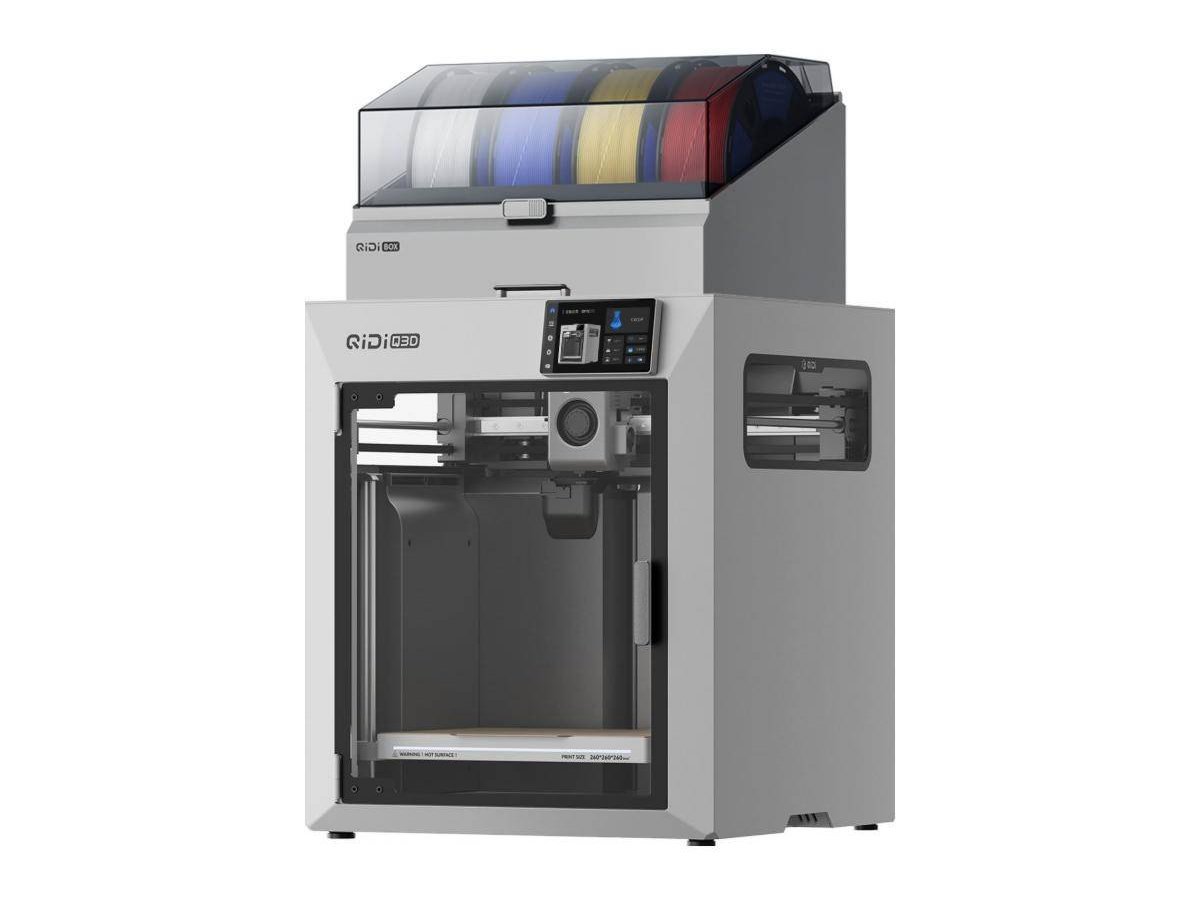
For more than two colours, the Q3D works with QIDI BOX, and the FAQ says up to four external BOX units can be connected. Filament tangle detection also requires a BOX. QIDI has not said how many colours the Q3D supports in total or how filament changes are split between the two nozzles when a BOX is attached.
A 70°C chamber for engineering filaments
The Q3D uses what QIDI calls its fourth-generation chamber heater, rated to 70°C, which is 5°C higher than the 65°C chamber on the QIDI Q2. A hotter chamber reduces warping and cracking in large ABS, ASA, PC and PA parts, and the heated bed reaches 120°C. QIDI also added dual external air intakes that pull outside air into the chamber to cool the filament, which it says improves overhangs and bridges.
QIDI also added a dedicated cooling duct for the extruder and claims it lowers the risk of heat-related clogs by up to 90%. An optional extruder cooler called the Polar Cooler is sold as a bundle, and QIDI recommends it for large models, high-temperature materials and long fibre-reinforced prints. The chamber air goes through a three-stage filter with a G3 pre-filter, an H12 HEPA filter and activated carbon.
QIDI Q3D specifications
| Specification | QIDI Q3D |
|---|---|
| Printer type | Enclosed CoreXY, main and auxiliary hotend in one toolhead |
| Build volume, main nozzle | 260 × 260 × 260 mm |
| Build volume, auxiliary or both nozzles | 240 × 260 × 255 mm |
| Max nozzle temperature | 350°C |
| Max bed temperature | 120°C |
| Chamber heating | Active, up to 70°C |
| Max toolhead speed and acceleration | 600 mm/s, 20,000 mm/s² |
| Extruder | Direct drive, hardened steel dual gears, 5.9:1 ratio, built-in filament cutter |
| Nozzles | Quick-swap bimetal, 0.4 mm standard, 0.2/0.6/0.8 mm optional |
| Levelling | Eddy current sensor in the hotend |
| Filtration | G3 pre-filter, H12 HEPA, activated carbon |
| Camera | HD camera with time-lapse and AI detection |
| Display | 4-inch touchscreen |
| Slicer | QIDI Studio, with PrusaSlicer and Orca also supported |
| Dimensions and weight | 405 × 475 × 441 mm, 29 kg |
Price and pre-order terms
Pre-ordering works in two steps: buyers pay a $30 deposit now, which QIDI says is refundable at any time, and pay the balance within seven days of receiving QIDI’s payment notice. QIDI expects to ship about three months after full payment, without guaranteeing the date. The deposit is not deducted from the balance, so every package works out $70 below its regular price, as shown in the prices on QIDI’s US store.
| Package | Regular price | Pre-order total |
|---|---|---|
| Q3D | $599 | $529 |
| Q3D + Polar Cooler | $749 | $679 |
| Q3D Combo | $749 | $679 |
| Q3D Combo + Polar Cooler | $899 | $829 |
QIDI’s launch announcement, as reported by Psych0h3ad, lists the $749 option as the Q3D with QIDI BOX2, although the US store page only calls it the Q3D Combo and does not list its contents. In Europe, the base model is €599 at regular price and €529 during the pre-sale. QIDI is running a Black Friday sale on its store at the same time, but the pre-order terms do not call the $529 figure a Black Friday price.
How it compares to the Bambu Lab X2D
The closest competitor is the Bambu Lab X2D, which launched in April 2026 and also puts two nozzles in one toolhead inside an enclosure with a heated chamber. The X2D’s left nozzle is direct drive and its right nozzle is fed through a Bowden tube, and the Q3D’s box contents point to a similar arrangement for its auxiliary nozzle.
| Specification | QIDI Q3D | Bambu Lab X2D |
|---|---|---|
| Build volume, main nozzle | 260 × 260 × 260 mm | 256 × 256 × 260 mm |
| Build volume, auxiliary or both nozzles | 240 × 260 × 255 mm | 235.5 × 256 × 256 mm |
| Max nozzle temperature | 350°C | 300°C |
| Max chamber temperature | 70°C | 65°C |
| Max bed temperature | 120°C | 120°C |
| US price | $529 pre-order, $599 regular | $589 Black Friday (until 1 December), $649 regular |
| Availability | Ships about 3 months after full payment | On sale now |
On paper, the Q3D has a hotter nozzle, a hotter chamber and a slightly larger print area on the bed, and its pre-order price is $120 below the X2D’s regular price. During Bambu Lab’s Black Friday sale the gap narrows to $60, and the X2D is already shipping while the Q3D is about three months away, so the Q3D’s spec advantage has to be weighed against the wait. Bambu Lab’s larger H2D uses the same dual-nozzle approach with a bigger build volume, but it costs $1,399 even in the Black Friday sale, so it sits in a different price class.
What is still unknown
- How the two nozzles switch, how long a switch takes and whether the idle nozzle is lifted or wiped
- The maximum temperature of the auxiliary nozzle
- Whether the Q3D still prints a prime tower or purges when switching nozzles, and how much waste that leaves
- How the auxiliary extruder is mounted and fed
- How many colours the Q3D supports with QIDI BOX2
- Pricing and availability in Malaysia
- How reliable the dual-hotend toolhead is once owners start printing with it
What to watch for next
The Q3D brings a 350°C main hotend and a 70°C heated chamber to a dual-nozzle printer at a pre-order price below the Bambu Lab X2D, which puts it in direct competition with the X2D for makers who print engineering materials with supports. None of QIDI’s speed and material-saving claims have been tested independently yet, and the switching mechanism and auxiliary nozzle limits are still unexplained. The first reviews after units ship, about three months after buyers complete payment, will show whether the Q3D lives up to its specifications, and we will update this article when QIDI publishes more details or confirms Malaysian pricing.
Sources
- QIDI Q3D 3D Printer, QIDI
- Frequently Asked Questions for QIDI Q3D, QIDI
- QIDI launches Q3D dual-nozzle 3D printer at Formnext 2026: Technical Specifications and Pricing, 3D Printing Industry
- Formnext 2026: QIDI Q3D with two hotends in one printhead, presale starting at €529, 3Druck
- QIDI Q3D Price, Specs, and Pre-Order Details, Makers101
- QIDI Q3D announced: dual-nozzle printing and pre-orders open, Psych0h3ad
- Xcellence made simple: Bambu Lab presents the X2D, Bambu Lab
- Bambu Lab X2D Brings Dual Extrusion & Heated Chamber for Half the H2D’s Price, All3DP
- Bambu Lab’s Black Friday Sale Officially On, X2D Drops to $589, All3DP
Don’t miss the latest articles and guides
Get new Domechy articles, guides and free models straight to your inbox.

Wanna share your thoughts or request anything? Comment below.