

Bambu Lab will reveal the H3C on 3 November at 9 AM EST, which is 10 PM in Malaysia, and since 23 October it has posted five official teasers across its H3C page, social media and community forum. Each one shows a different feature, so this article puts them in one place and explains what they mean, especially the hardened nozzle claim of “HRC 55+”, which is not a figure most hobbyists deal with.
As a short disclaimer, Bambu Lab has not published the H3C’s price or full specifications at the time this article is written, so this article is based only on the official teasers and the store listing for a new filament.
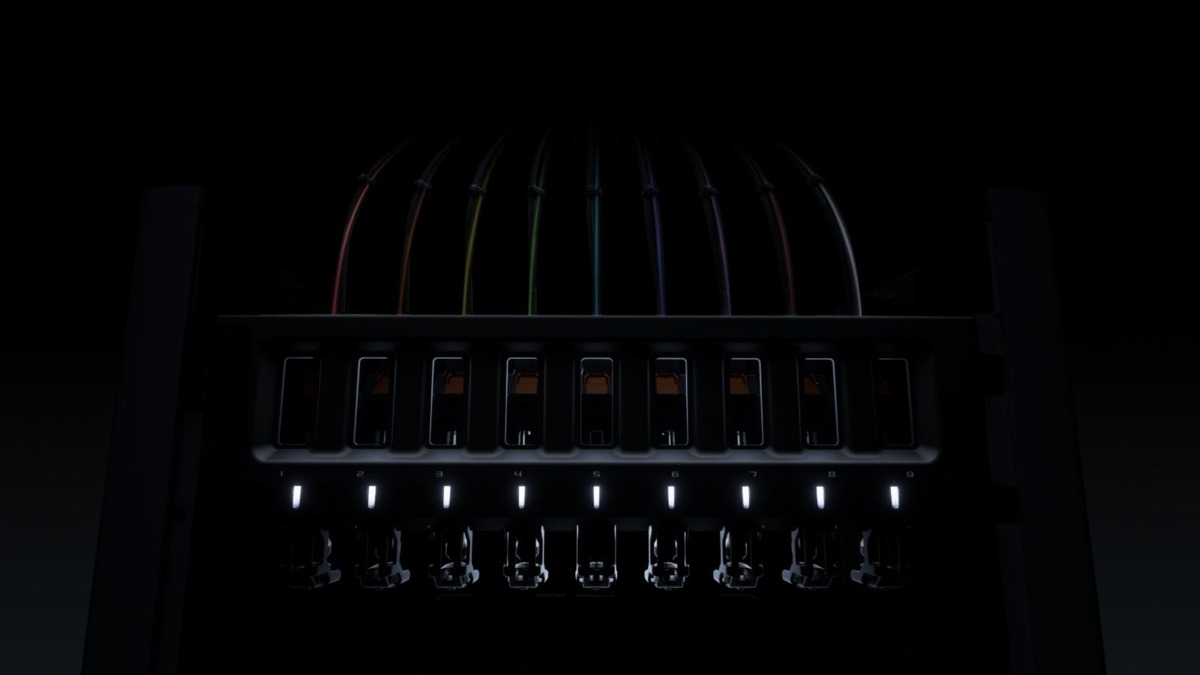
Every official teaser so far
| Date | What Bambu Lab posted | What it shows |
|---|---|---|
| 23 October | “Tool Changer. Game Changer.” video on the H3C page | Nine tools in a rack that drops down at the front of the chamber |
| 26 October | Shoes “printed in one build on Bambu Lab H3C” | Soft TPU 75A and firmer TPU 90A combined in one print |
| 28 October | “Retractable rack. Full Visibility.” video | The rack lifts clear of the build area during printing, with one dock left empty while its tool prints, which points to nine tools in total |
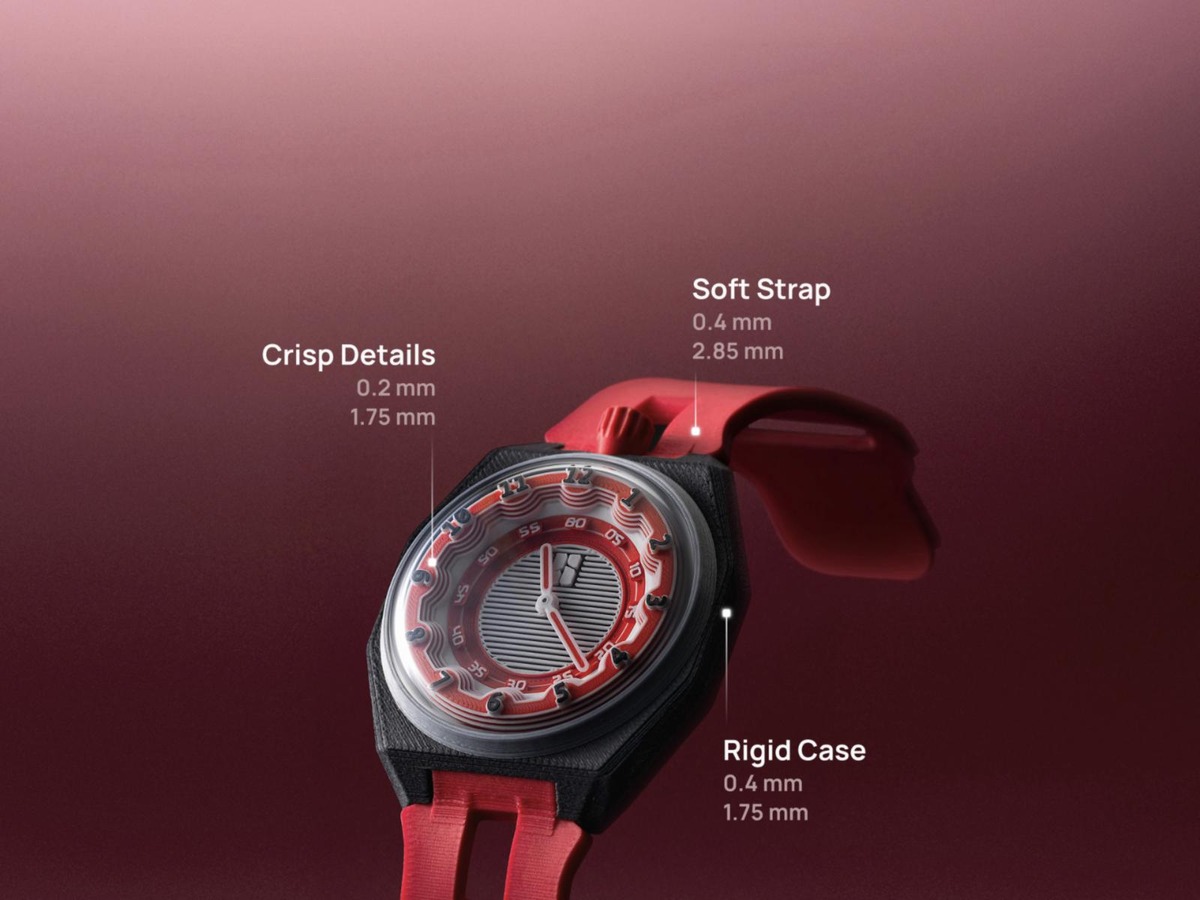
| 29 October | “Do I pick 0.2 or 0.4? YES.” | A watch printed with 0.2 mm and 0.4 mm nozzles, and 1.75 mm and 2.85 mm filament |
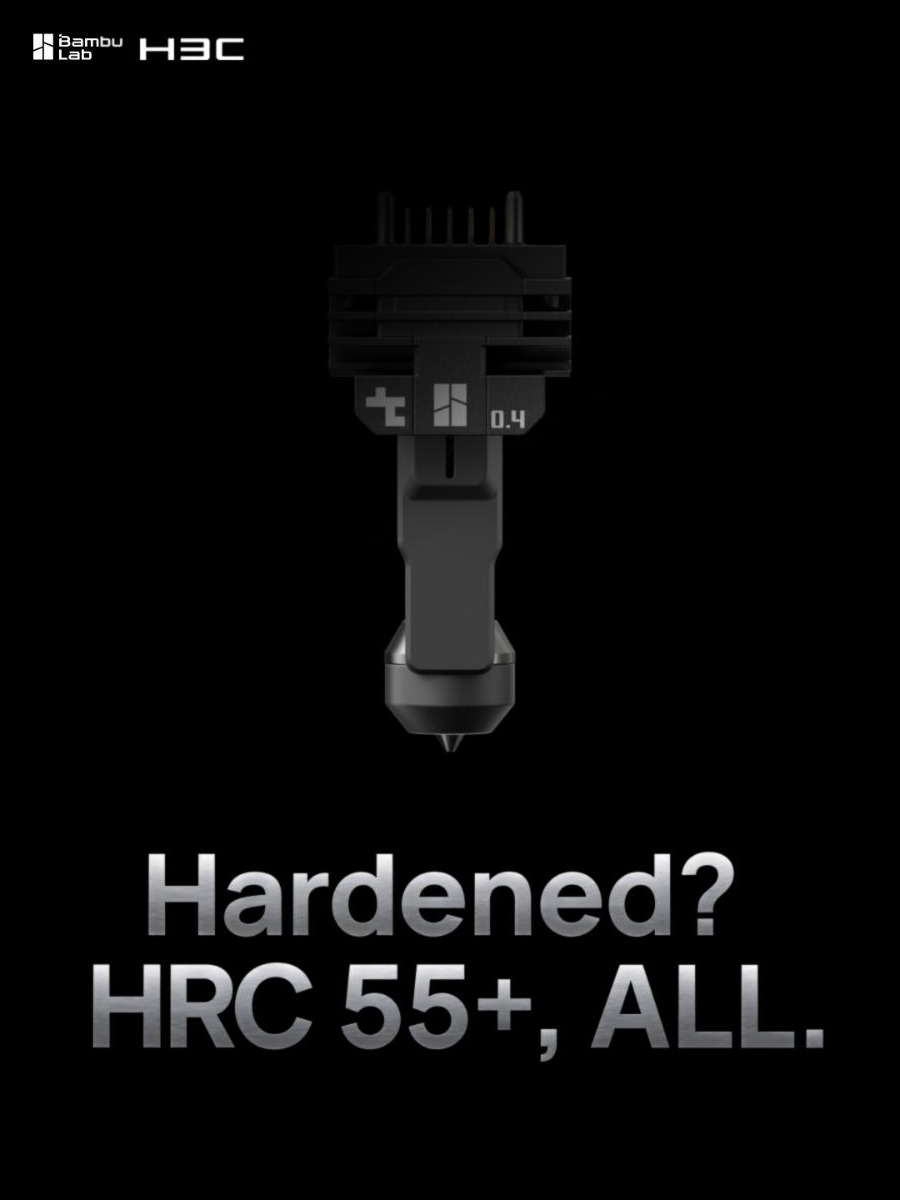
| 30 October | “Hardened? HRC 55+, ALL.” | Every nozzle is hardened to HRC 55 or above |
What “HRC 55+” means
HRC is a hardness value on the Rockwell C scale, which is measured by pressing a diamond cone into the material under a fixed load and measuring how deep it goes, so a higher number means a harder surface that resists wear better. The C scale is used for hard materials such as heat-treated steel, and soft metals like brass are too soft to be measured on it at all.
| Nozzle material | Approximate hardness | Suitable for |
|---|---|---|
| Brass | Too soft for the HRC scale | PLA, PETG and other unfilled filaments |
| Typical stainless steel nozzles | Below the hardened steel range, since most use non-hardened grades | Unfilled filaments, with some resistance to light abrasion |
| Hardened tool steel | Around HRC 55 to 62 | Carbon fibre, glass fibre and other abrasive filaments |
| Tungsten carbide | Harder than any steel | Heavy, long-term use with abrasive filaments |
This matters because filaments filled with carbon fibre, glass fibre or glow-in-the-dark particles act like fine sandpaper on the inside of the nozzle, so a brass nozzle wears much faster with them, and as the hole widens, extrusion and print quality drift. HRC 55 sits in the normal range for hardened tool steel, so in practical terms Bambu Lab is saying the H3C’s nozzles are made to handle abrasive filaments, although hardness alone does not set how long a nozzle lasts, since the material, the filament and how much is printed all play a part.
The more important word in the teaser is “ALL”. On a single-nozzle printer, you can simply fit one hardened nozzle and use it for everything, but a toolchanger with nine nozzles would otherwise force a choice about which tools can take abrasive filaments. If every H3C nozzle is hardened by default, wear is no longer a reason to keep abrasive filament out of a particular tool, and there is no need to buy separate hardened nozzles. Nozzle size still matters, since fibre-filled filaments are generally not recommended for 0.2 mm nozzles because the fibres can clog the small opening, so fibre-filled filaments would still need the nozzle size their filament guide recommends, which is usually 0.4 mm or larger and for some materials 0.6 mm. Bambu Lab has not said whether “ALL” covers only the nozzles or other parts of the tool, or whether tungsten carbide nozzles will be offered as an option.
Mixed nozzle sizes and 2.85 mm filament in one print
The watch teaser shows three settings in a single print, with 0.2 mm nozzles and 1.75 mm filament for the fine details on the face, 0.4 mm nozzles and 1.75 mm filament for the rigid case, and a 0.4 mm nozzle with 2.85 mm filament for the soft strap. A smaller nozzle gives sharper detail but prints slowly, while a larger one is faster for bulk areas, so mixing sizes lets one print use each where it suits.
The 2.85 mm filament is the bigger surprise, since every Bambu Lab printer so far has used 1.75 mm. Bambu Lab has already listed TPU 75A in 2.85 mm on its store, and the listing says it is ultra-soft for wearables, prints reliably through something Bambu Lab calls FlexFeed, runs at up to 10 mm³/s and is certified for skin contact, although it does not name the certification. Bambu Lab has not explained why it chose 2.85 mm, but very soft TPU is known to be difficult to feed at 1.75 mm because the thin strand buckles in the extruder, and a thicker strand is stiffer and pushes through more reliably, so that is the most likely reason.
What is still unknown
Bambu Lab has not published the H3C’s price, build volume, how FlexFeed works, or whether each of the nine tools is a complete toolhead or a lighter nozzle module, and the HRC 55+ image shows a slim module with a heatsink and nozzle rather than a full toolhead. Bambu Lab is expected to share more details at the reveal on 3 November at 10 PM Malaysia time, and we will cover the full announcement then.
Sources
- Bambu Lab H3C page
- Bambu Lab on X: “Retractable rack. Full Visibility.”
- Bambu Lab on X: “Do I pick 0.2 or 0.4? YES.”
- Bambu Lab on X: “Hardened? HRC 55+, ALL.”
- [Bambu Lab H3C] TPU 75A: Our softest yet, Bambu Lab Community Forum
- TPU 75A (2.85mm), Bambu Lab Store
- Bambu Lab P3C and H3C Toolchanger Leaks, Domechy
Don’t miss the latest articles and guides
Get new Domechy articles, guides and free models straight to your inbox.

Wanna share your thoughts or request anything? Comment below.