
Bambu Lab’s September filing spree did not stop at printers, because two new filament systems called the AMS 3H and AMS 3P were certified by the FCC on 21 September 2026, the same day as the R1 laser cutter and one day before the S1 3D scanner.
As a short disclaimer, Bambu Lab has not announced either unit at the time this article is written, so everything here comes from the public FCC records and the product labels included in them, not from anything Bambu Lab has said or shown.
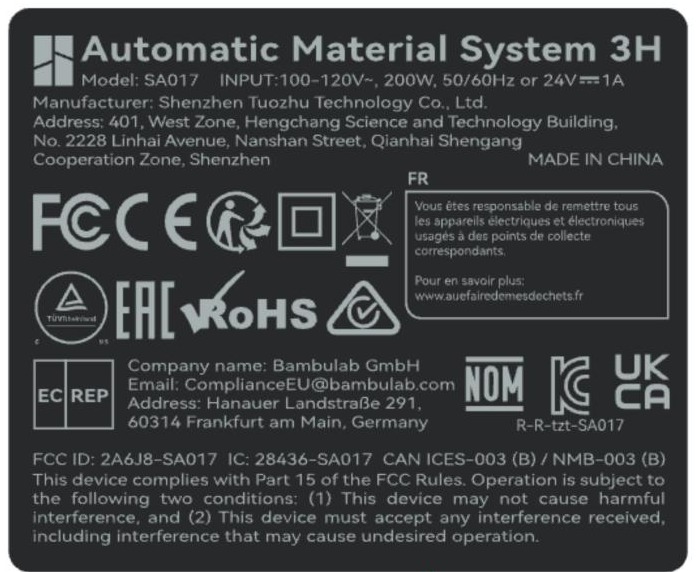
Most of the early coverage stopped at the product names. The labels inside the filings carry more than that, since each one lists the unit’s power input, and the two units turn out to be built very differently. The AMS 3H is rated for 200 W of mains power, while the AMS 3P is rated for only 24 V at 1 A. Neither label says anything about drying directly, but the two ratings give a fair indication of which unit is more likely to have a heater.
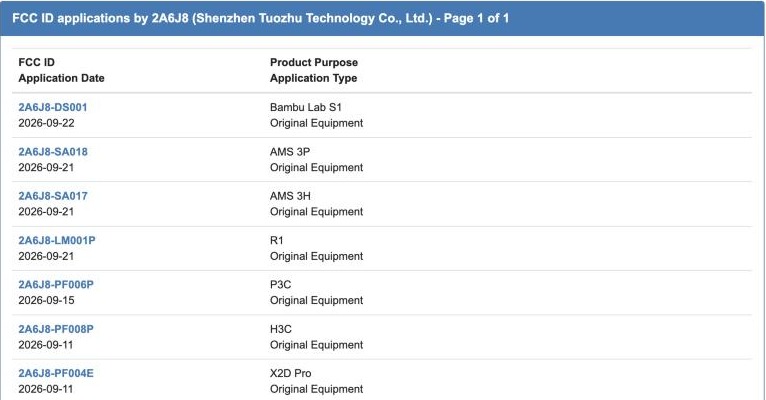
What the two filings show
| Item | AMS 3H | AMS 3P |
|---|---|---|
| FCC ID | 2A6J8-SA017 | 2A6J8-SA018 |
| Model | SA017 | SA018 |
| Applicant | Shenzhen Tuozhu Technology Co., Ltd. | Shenzhen Tuozhu Technology Co., Ltd. |
| Grant date | 21 September 2026 | 21 September 2026 |
| Radio | 13.56 MHz, Part 15C low power transmitter | 13.56 MHz, Part 15C low power transmitter |
| Input rating on label | 100 to 120 V AC, 200 W, 50/60 Hz, or 24 V DC at 1 A | 24 V DC at 1 A |
| Photos and user manual | Confidential until 20 March 2027 | Confidential until 20 March 2027 |
Shenzhen Tuozhu Technology is the company behind Bambu Lab, and both labels name the products in full as “Automatic Material System 3H” and “Automatic Material System 3P”, so there is no doubt about what these are. The 13.56 MHz radio in both filings is the same band covered in the FCC filings for the AMS 2 Pro and the AMS HT, which is the band used for reading the RFID tags on Bambu Lab filament spools. Neither filing lists Wi-Fi or Bluetooth, which is consistent with the current AMS units, since those talk to the printer through a cable.
The AMS 3H has a 200 W mains input
The AMS 3H label lists its input as 100 to 120 V AC at 200 W, with an alternative input of 24 V DC at 1 A. The label file in the filing is named “3H美规”, which means US-specification version, so the 100 to 120 V range reflects the American market, and a version sold elsewhere would most likely carry a 220 to 240 V rating instead.
| Unit | Power input | Drying |
|---|---|---|
| AMS 2 Pro | 24 V DC at 4 A (label rating) | Up to 65°C, external power adapter required for drying |
| AMS HT | 24 V DC, plus 100 to 240 V AC with 150 W average power (Bambu Lab spec) | Up to 85°C |
| AMS 3H | 100 to 120 V AC at 200 W, or 24 V DC at 1 A (label rating) | Not stated |
| AMS 3P | 24 V DC at 1 A (label rating) | Not stated |
The AMS 3H follows the same two-input layout as the AMS HT, with a 24 V DC input alongside a mains input, and the AMS HT uses its mains supply for drying. A feeding mechanism and an RFID reader would not need a 200 W mains input on their own, so the most likely reading is that the AMS 3H has a built-in heater for drying.
The 200 W figure does not tell us how well that heater dries, though. It is a maximum input rating printed on a label, while Bambu Lab’s 150 W figure for the AMS HT is average power, so the two numbers do not compare directly. Drying performance also depends on the heater design, airflow, insulation and the maximum temperature, and the filing states none of these. The second input of 24 V at 1 A is only 24 W, which suggests the unit can handle feeding and RFID reading on printer power, with mains power needed only when the heater is on. That is my interpretation of the label, and the filing does not explain it.
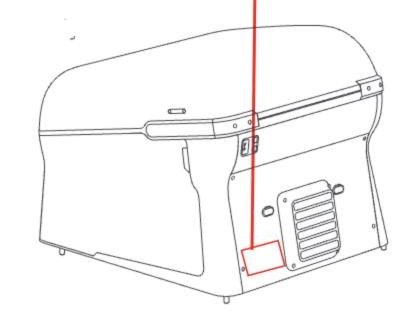
The label location drawing is the only view of the AMS 3H’s shape, because the external photos are confidential. It shows a box with a long hinged lid and a slatted grille on the side panel. A heated unit has to release the moisture it drives out of the filament, so a grille like this fits the heater reading, although the drawing itself does not say what the grille is for. The drawing also does not show how many spools the unit holds.
The AMS 3P runs on 24 V at 1 A
The AMS 3P label lists a single input of 24 V DC at 1 A, which is 24 W. That is a quarter of the 24 V at 4 A on the AMS 2 Pro label, and the AMS 2 Pro still needs an external power adapter before it can dry filament. A 24 W budget makes heated drying of the kind the AMS 2 Pro and AMS HT offer unlikely, but it does not rule out heating entirely, since the unit could have a low-power humidity control function, or take drying power from a separate supply that this label does not list. Based on the label alone, the AMS 3P looks more like a feeding unit than a dryer, which is a reading of the rating and not something the filing states.
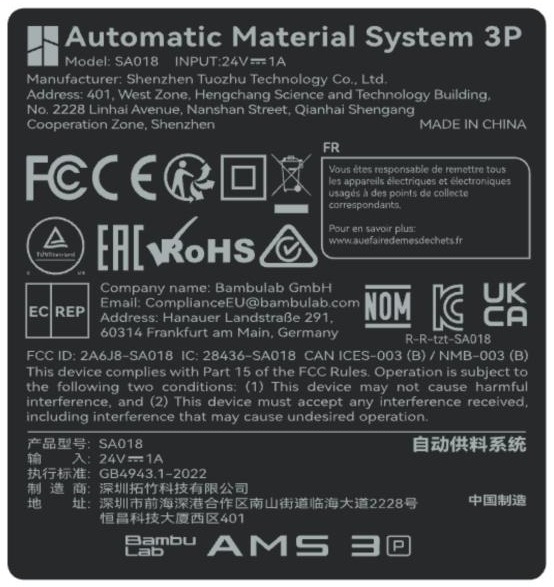
Some early posts on the Bambu Lab forum attributed the 200 W figure to the AMS 3P. The labels show that figure belongs to the AMS 3H, and the AMS 3P is the lower powered unit of the two.
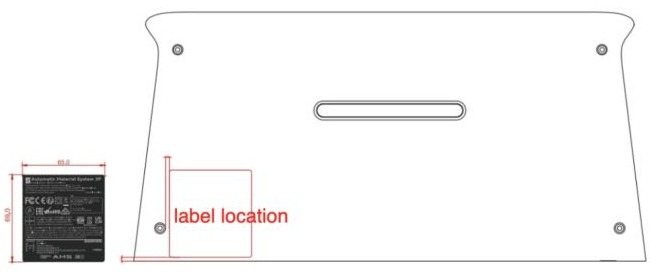
The AMS 3P label location drawing shows a single flat panel with a slot near the top and four screw points, so it tells us almost nothing about the overall shape of the unit.
Which printers they are for is still unknown
The AMS 3H and AMS 3P were certified ten days after the H3C and six days after the P3C, which we covered in our article on the H3C and P3C FCC filings, and the letters in their names match. That makes it tempting to pair the AMS 3H with the H3C and the AMS 3P with the P3C, but matching letters and close filing dates are weak evidence. Bambu Lab’s earlier naming does not always follow printer series, since the H in AMS HT stands for high temperature rather than for the H2 series, so the H in AMS 3H could just as well refer to heating. Neither filing mentions which printers these units work with, so compatibility stays an open question until Bambu Lab announces it.
Regulatory marks for many markets
Both labels carry more than the FCC mark. They also show the Canadian IC number, CE, UKCA, the Korean KC mark with registration numbers R-R-tzt-SA017 and R-R-tzt-SA018, Mexico’s NOM, the RCM mark used in Australia and New Zealand, and EAC. A mark printed on a label shows which markets the label was designed for, but it does not by itself prove that approval has been granted in each of them, and the FCC grant is the only approval confirmed by a public record so far. Even so, a label prepared for this many regions suggests Bambu Lab is planning a broad release rather than a single-market one. For those of us in Malaysia, SIRIM certification is a separate process that does not appear on these labels, so a local release can still trail the global one.
What is still unknown
The filings do not reveal how many spools either unit holds, whether the AMS 3H actually dries filament and at what temperature, which printers each unit works with, the price or the release date. The external photos, internal photos and user manuals for both units are under short-term confidentiality until 20 March 2027, so if Bambu Lab has not announced the units by then, the photos and manuals will become public on their own.
With the humidity we deal with in Malaysia, the difference between the two labels has a direct cost. If the AMS 3H turns out to be the drying unit and the AMS 3P does not dry, buyers of whichever printer comes with the AMS 3P would still need a separate filament dryer on top of it.
For now the labels tell us that Bambu Lab is preparing two different AMS units, one with a mains power input that points to heating and one without, and that both have cleared the FCC. We will update this article when Bambu Lab announces either unit or when more of the filings become public.
Sources
- FCC ID 2A6J8-SA017, AMS 3H equipment authorisation
- FCC ID 2A6J8-SA018, AMS 3P equipment authorisation
- Shenzhen Tuozhu Technology FCC applications list (grantee code 2A6J8)
- FCC ID 2A6J8-SA007, AMS 2 Pro label
- FCC ID 2A6J8-SA008, AMS HT label
- Bambu Lab AMS 2 Pro, Bambu Lab Store
- Bambu Lab AMS HT specifications, MatterHackers
- New AMS 3P, 3H? thread, Bambu Lab Community Forum
- H3C, X2D Pro, P3C, R1, AMS 3H, AMS 3P and S1 registered with FCC thread, Bambu Lab Community Forum
- Bambu Lab H3C and P3C Are Coming? FCC Filings Found, Patents Show a 10-Nozzle Hotend Changer, Domechy
Don’t miss the latest articles and guides
Get new Domechy articles, guides and free models straight to your inbox.

Wanna share your thoughts or request anything? Comment below.