
Bambu Lab has not announced printers called the H3C or P3C. This article is based on US FCC filings and three Chinese patent applications, not on an official announcement or hands-on access to the machines.
For those who are not familiar with it, the FCC (Federal Communications Commission) is the US government agency that regulates devices which transmit radio signals. Devices that intentionally transmit radio signals, such as those with Wi-Fi or Bluetooth, must be authorised by the FCC before they can be marketed or sold in the United States. Because of that, a new FCC filing is often one of the first public signs that a product is close to launch.
Both names appeared in mid-September 2026, when the FCC certified Bambu Lab devices listed as the H3C on 11 September and the P3C on 15 September. Separately, China’s patent office published three Bambu Lab applications in August describing a printer that swaps between ten hotends. Nothing official links the two, so while both printer names are confirmed, their connection to the patented design is still speculation.
What is confirmed and what is not
| Information | Status |
|---|---|
| Bambu Lab has FCC-certified printers called the H3C and P3C | Confirmed |
| Bambu Lab has patent applications for a 10-nozzle hotend-changing system | Confirmed |
| The “C” in both names means hotend changing, as on the H2C | Unconfirmed, based on naming |
| Either printer uses the patented system | Unconfirmed |
| Announcements are coming soon | Likely, based on past FCC timing |
| Price, specifications and launch date | Unknown |
What the FCC filings show
The H3C and P3C were certified four days apart, and both are registered to Shenzhen Tuozhu Technology, the company behind Bambu Lab. Their photos and user manuals are kept confidential until March 2027, so neither filing shows what the printers look like. The P3C’s label document is public, however, and it lists the device as a 3D printer carrying the Bambu Lab P3C name.
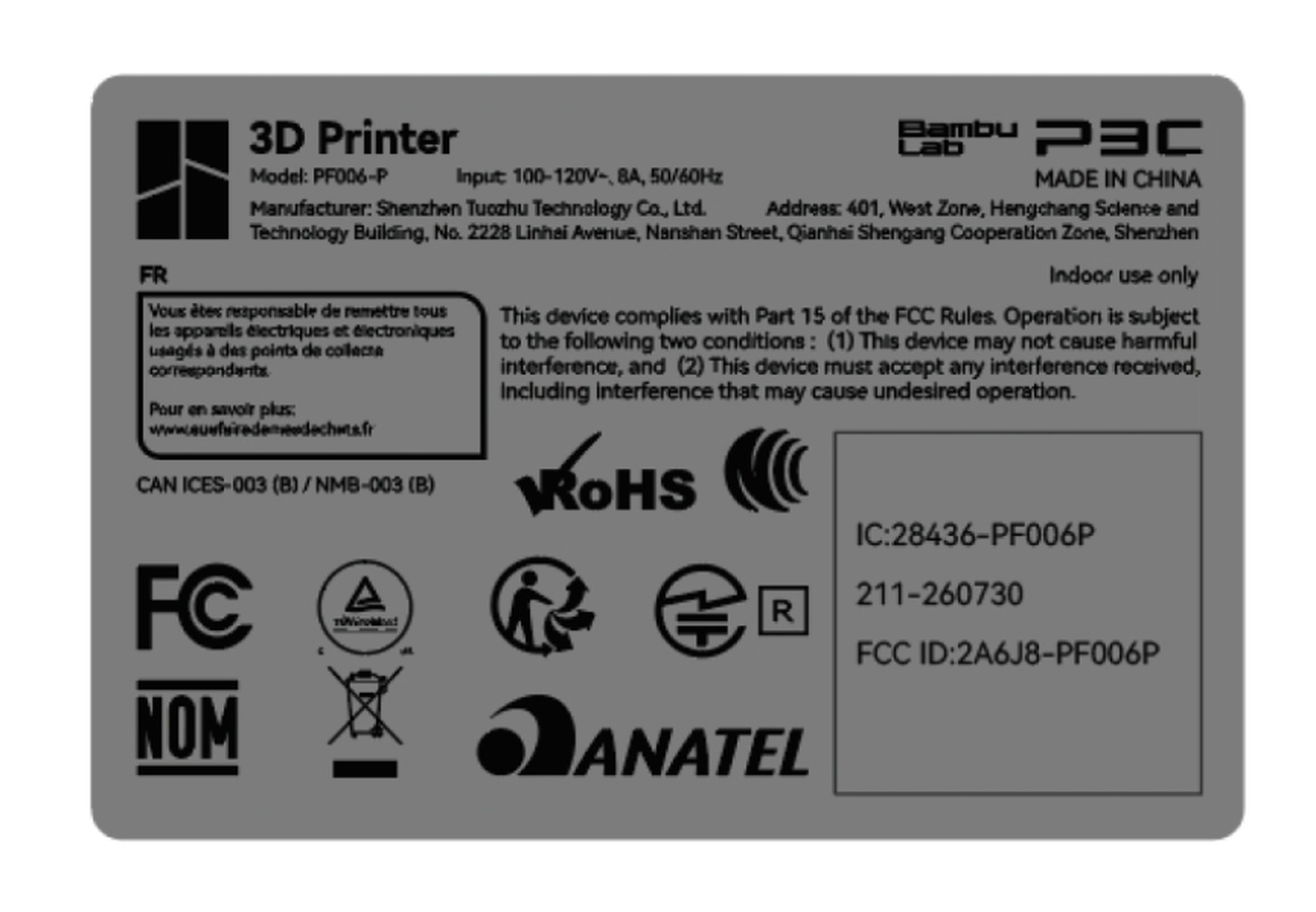
The names follow a familiar pattern. The H2C is the version of the H2 series with Vortek hotend changing, so if the letter carries the same meaning, the H3C and P3C would be third-generation H and P series printers with hotend changing. That would bring the feature to the P series for the first time. Bambu Lab has not said what the letter means on either machine.
Bambu Lab’s recent printers have also appeared at the FCC within a few days of launch. The H2C was certified on its launch day and the X2D two days before its launch, so announcements for the H3C and P3C may not be far off, although Bambu Lab has not given any date.
What the patents describe
The three patent applications were published on 14 August 2026, and two of them trace back to an earlier filing from November 2025, which means Bambu Lab has been working on this design since at least late 2025. None of them mentions a product name.
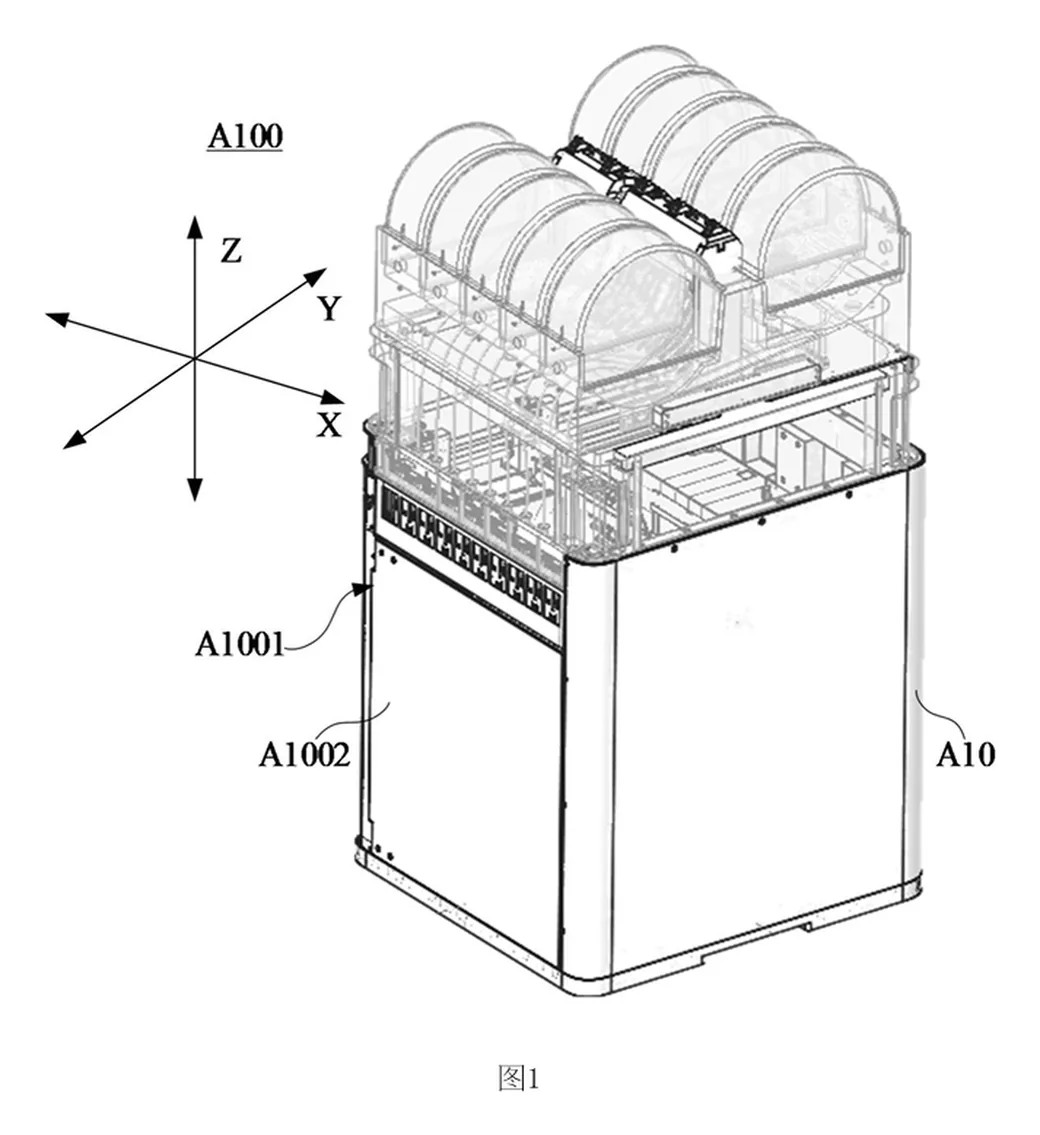
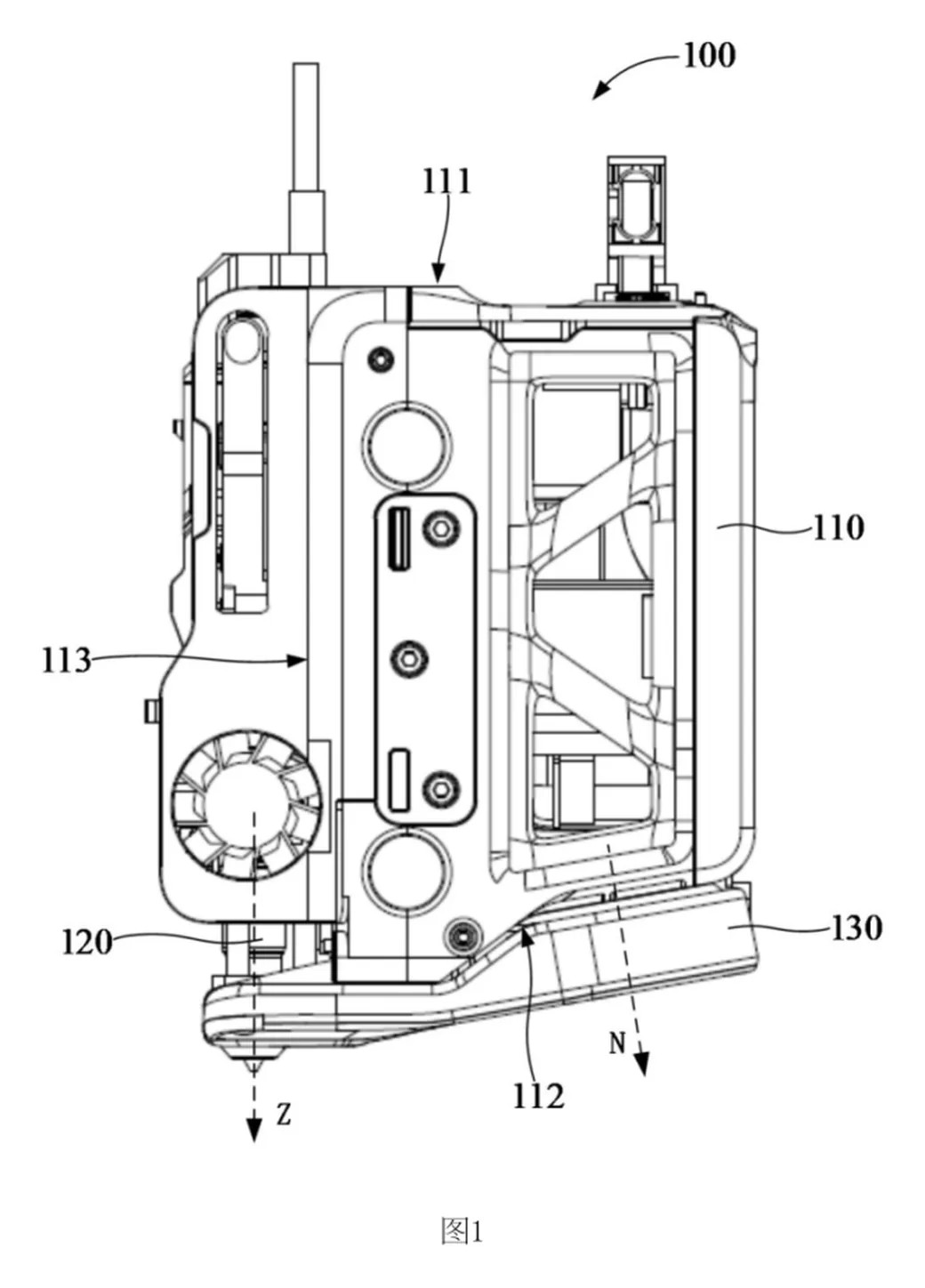
The drawings show ten filament spools across the top of the machine and a rack along the back holding nine hotend modules, with a tenth module on the toolhead. That gives ten nozzles in total, compared with seven on the H2C. The extruder stays on the toolhead, and only the module carrying the nozzle, the heater and its own section of filament path is swapped. This makes it a hotend changer using the same basic approach as Vortek on the H2C, on a larger scale.
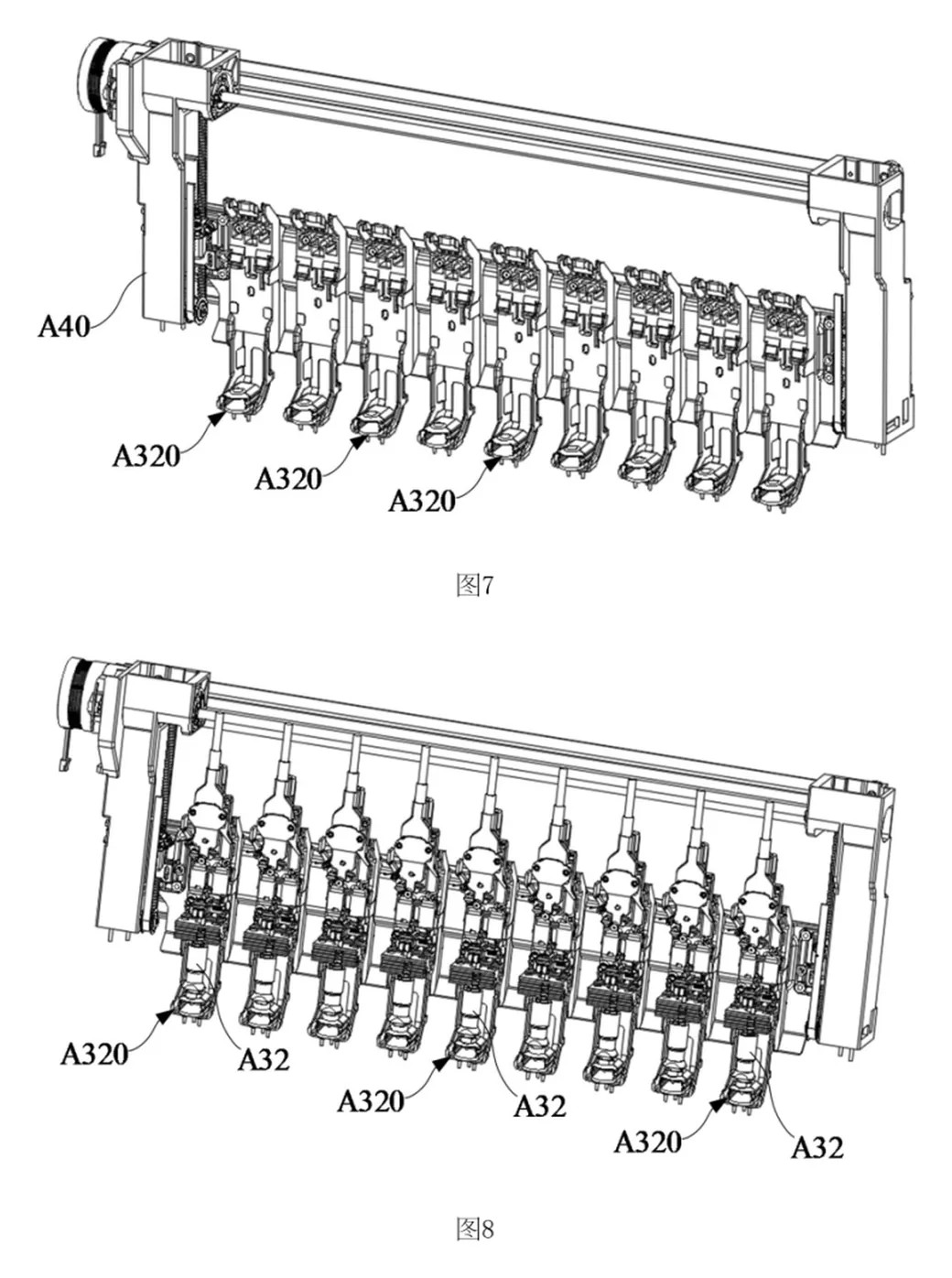
The swap is designed to be quick. Unlocking a module from the toolhead and parking it in the rack happen in a single movement, and magnets hold each module in place during docking. The patent uses a wired connection to each module, with induction heating listed as an alternative.
The toolhead patent adds a light inside the part-cooling duct, with a matte black surface to absorb light and a matte white surface to reflect it onto the nozzle tip. This keeps the nozzle brightly lit for a camera, which would help a machine with many nozzles watch for extrusion problems.
How it compares to the H2C
| H2C (on sale) | Patent drawings | |
|---|---|---|
| Nozzles | 7 (6 swappable plus 1 fixed) | 10 (9 in a rack plus 1 on the toolhead) |
| Rack position | Right side of the chamber | Along the back of the machine |
| Filament supply | External AMS units | Ten spools on top of the machine |
| Build volume | 330 x 320 x 325 mm | Unknown |
Why this direction matters
Bambu Lab built its reputation on the AMS, which feeds several filaments into one nozzle and purges the old material at every colour change. Giving each filament its own hotend could substantially reduce that waste, although a hotend that has been sitting idle usually still needs some priming before it prints cleanly.
Nozzle-swapping machines have also become increasingly prominent in 2026, from the four-tool Snapmaker U1 to a 12-nozzle machine shown at CES in January. A ten-nozzle Bambu Lab printer would sit near the top of that group.
What it means for H2C owners and buyers
Members on the Bambu Lab community forum have already discussed what an H3C would mean for recent H2C buyers. For anyone in Malaysia looking at an H2C now, it is a proven machine with around ten months of owner feedback behind it, while nothing is known yet about the H3C or P3C, including their price or whether either uses the patented design.
What to watch for next
The FCC filings confirm that the H3C and P3C exist, and the patents show a ten-nozzle design Bambu Lab has been working on since late 2025. Whether either printer uses that design is still an open question. The next useful piece of information will be an official teaser or launch page, and I will update this article once Bambu Lab publishes actual specifications.
Sources
- FCC ID 2A6J8-PF008P, Bambu Lab H3C
- FCC ID 2A6J8-PF006P, Bambu Lab P3C
- P3C FCC label and label location document
- H3C and X2D Pro printer registered with FCC, Bambu Lab Community Forum
- CN122560413A, shelf and 3D printer, Patsnap Eureka
- CN122560409A, tool heads, 3D printers and 3D printing systems, Patsnap Eureka
- Bambu Lab H3C: What Bambu’s New Patents Actually Show, Makers101
- Bambu Lab Patent Shows a Nine-Bay Hotend Rack, 3DPCC
- Bambu Lab patents detail automatic printhead changing and nozzle monitoring systems, 3D Printing Industry
- AtomForm Unveils the Palette 300 at CES 2026, a 12-Nozzle Multi-Material 3D Printer, PR Newswire
- Bambu Lab Launches H2C With New Vortek Hot-End Swapping System, Fabbaloo
Don’t miss the latest articles and guides
Get new Domechy articles, guides and free models straight to your inbox.

Hrp harga bawah 5k 😂
haha kalau H3C rasanya harga rm10k ke atas. tapi kalau P3C ada harapan bawah rm5k