

As some of you may already know, this printer has not been released yet. So this article is based on Creality’s own teaser page and the coverage published since it went live around 19 August 2026, not on personal experience using the machine. No independent test units exist yet, and there is no price, no ship date, and no announced crowdfunding platform.
What I have done here is gather everything announced so far: the full spec sheet, how the QuarTeks system works, and the test figures Creality published themselves. All of it is still manufacturer’s material at this stage. We wait for real units to reach independent reviewers before anyone can confirm which parts hold up.
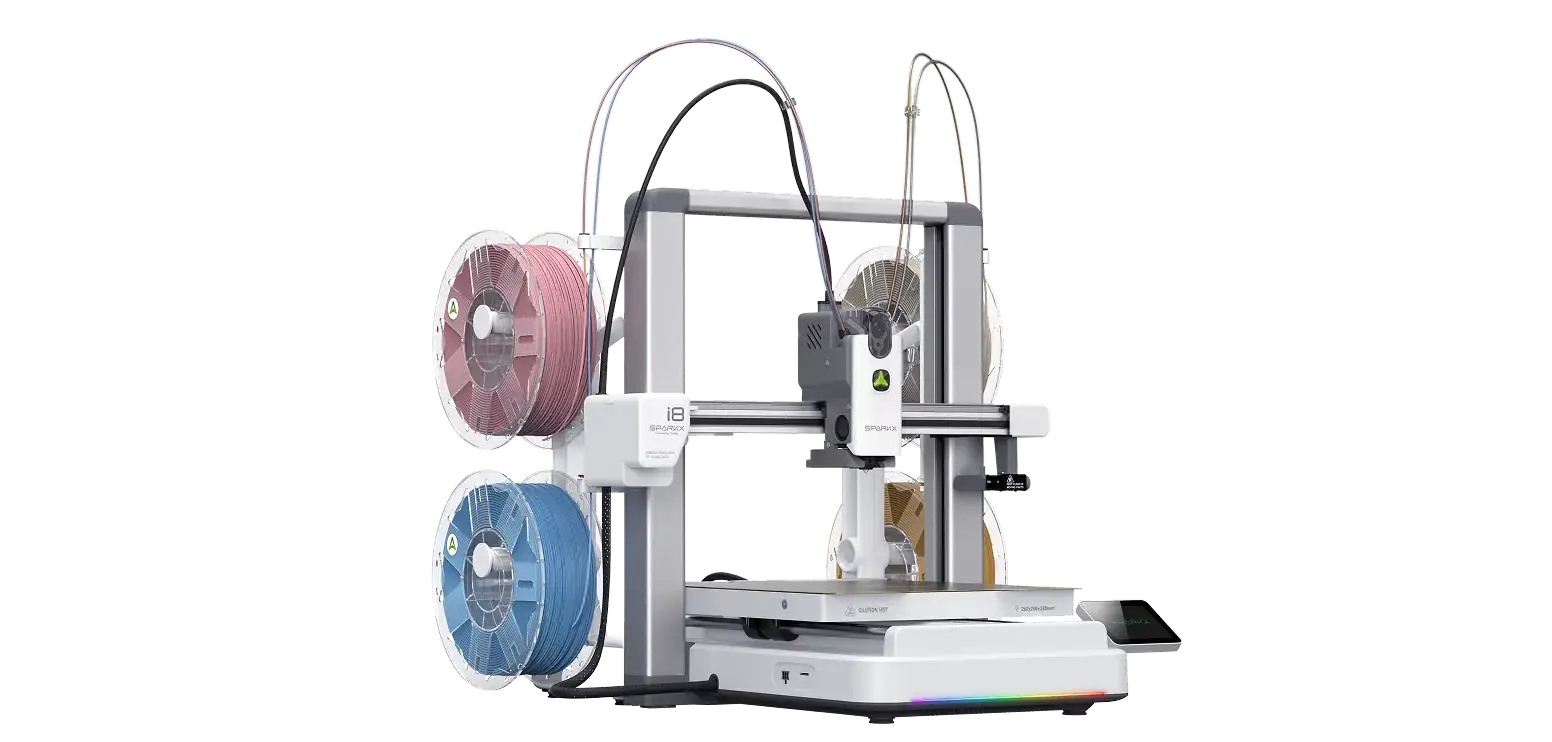
What Creality announced
The SPARKX i8 is a four-colour FDM printer that feeds all four filaments through a single nozzle. That in itself is not new, since plenty of printers already do four colours through one nozzle. What is new is where the four filament paths meet.
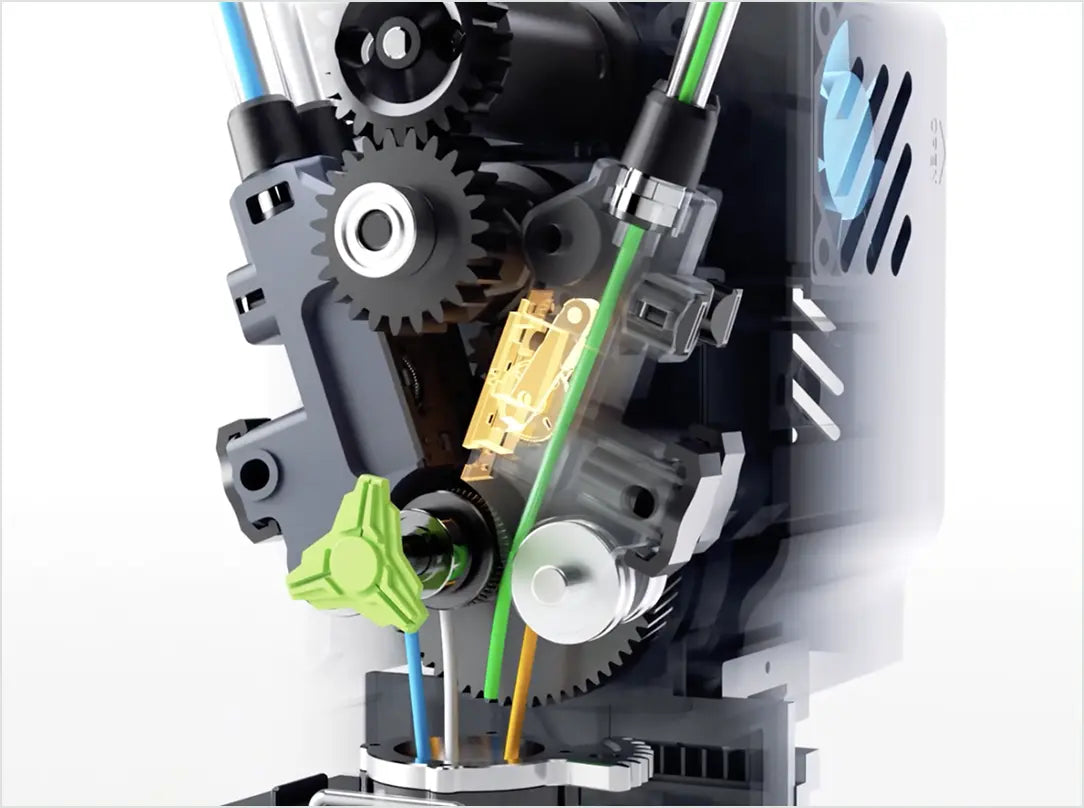
On a typical single-nozzle multicolour setup, the four filaments are selected somewhere back at the extruder or inside an external box, then travel down one shared tube into the hotend. That shared section is where the waste comes from. Every time the printer switches colour, whatever is sitting in that shared path has to be pushed out before the new colour prints clean, and that pushed-out material becomes purge. It is the reason a four-colour print can consume three times the filament of the same model in a single colour.
Creality’s answer is a system they call QuarTeks. The four channels merge 1.7 mm from the nozzle rather than back at the extruder, which leaves far less material to flush on each change. Creality claims a colour change completes in under one second.
Everything else on the spec sheet follows from that one design decision. This approach is rather interesting because it deals with the root of the problem instead of adding more hardware around it. The open question is whether a 1.7 mm shared path can handle four filaments converging into a 0.4 mm nozzle over hundreds of hours of use. Only real long-term use will answer that.
The published spec sheet
| Spec | SPARKX i8 |
|---|---|
| Build volume | 260 x 260 x 255 mm |
| Technology | FFF, open frame |
| Max print speed | 500 mm/s |
| Max acceleration | 10,000 mm/s² |
| Hotend max temp | 300 °C |
| Heated bed max | 100 °C |
| Nozzle | 0.4 mm, 5 second quick release |
| Multicolour | QuarTeks, integrated four channel single toolhead, up to 4 colours |
| Shared filament path | 1.7 mm |
| Colour switch time | Under 1 second (claimed) |
| Levelling | 81 point auto levelling with micro levelling, auto Z offset |
| Sensors | 13 intelligent sensors, with per channel runout, slipping and empty extrusion detection |
| Camera | 720p, up to 30 fps, AI vision, auxiliary light |
| Display | 2.85 inch, 640 x 480 |
| Build plate | Dual sided gold textured PEI, magnetic |
| Noise | 45 dB or lower |
| Connectivity | 2.4 GHz Wi-Fi, Creality Cloud, LAN, offline |
| Storage | 8 GB microSD included |
| Machine size | 467 x 423 x 456 mm |
| Package size | 524 x 519 x 332 mm |
| Net weight | 9.72 kg |
| Power | 100 to 120 VAC / 200 to 240 VAC, 50/60 Hz |
| Assembly | 90% pre-assembled |
| OS support | Windows, macOS, Linux |
There are two things in that table worth pointing out. The first is that it is 2.4 GHz Wi-Fi only, which is a limitation you will notice on a printer with a camera meant for remote monitoring, particularly if your home network is already crowded on that band.
The second is that this is an open frame machine with a 300 °C hotend, and Creality has not published a full material compatibility list for the i8. A high hotend temperature on its own does not make a printer suitable for ABS or ASA, so it is worth waiting for the official list before planning around those materials.
Creality’s four headline claims
Creality’s page leads with four numbers. Here is what each one means, and the context behind it.
“5x Faster Printing”
Creality published a comparison of the same model printed on four different machine types.
| Machine type | Time |
|---|---|
| SPARKX i8 | 14h 41min |
| 4-toolhead changer | 18h 24min |
| 7-hotend changer | 32h 48min |
| 4-colour bedslinger | 90h 41min |
Creality does not say which machine the 5x figure is based on. Working from their own table, the i8 is 1.25x faster than the toolhead changer, 2.2x faster than the seven-hotend machine, and 6.2x faster than the bedslinger. So the real figure depends on which machine you compare against.
The competing machines in the table are not named either, so the test cannot be reproduced yet. That is normal for pre-launch marketing material.
“Under 1 second filament switching”
This is the claim most directly tied to the 1.7 mm design, and it will be one of the first things independent reviewers measure. We should know shortly after the first units ship.
“0 g Waste”
The footnote on this one reads “No External Purge Waste.” What that means is that no purge material is discarded outside the print.
On select models the purge is redirected into the part’s own infill instead of being extruded into a waste bin. The filament still comes off the spool, but it gets used inside the print rather than thrown away. That is a good idea, because the infill has to be printed anyway.
For the full picture, Creality cites 2.7 times less filament waste in one place, while the purge comparison image on the same page shows 15.1 g for the i8 against 79.5 g for an unnamed competitor. Those are presumably two different tests.
“438 kg less filament, over 400 spools, around USD 1,500 saved” per year
This figure comes from Creality’s Crystal Dragon test, which used 183.57 g on the i8 against 619.55 g on the comparison machine, a saving of 435.98 g per print.
To reach 438 kg in a year, that assumes roughly 1,005 prints of that kind, or about 14,750 hours of printing. So the annual number describes the ceiling at very heavy use rather than what most of us print day to day.
The more useful figure to work from is the per-print saving above. Creality also puts the annual value at USD 1,500, which implies filament at about USD 3.42 per kg. Compare that against what you actually pay locally and adjust the number accordingly.
The rest of the published test data
For completeness, here is the remaining comparison data from the page, with the same unnamed “others” in each case.
| Model | i8 time | Others | i8 filament | Others |
|---|---|---|---|---|
| Crystal Dragon | 14h 41min | 42h 18min | 183.57 g | 619.55 g |
| Cubeme Mona Lisa | 11h 01min | 32h 08min | 238.45 g | 534.83 g |
| Pilot Cat Helmet | 14h 39min | 32h 43min | 299.46 g | 549.01 g |
| Colour Puzzle Cube | 3h 13min | 14h 08min | 96 g | 249 g |
That works out to 2.2x to 4.4x on time and 1.8x to 3.4x on filament across four different models. What is more interesting here is not the headline numbers but the consistency across those four tests. If those figures hold up under independent testing, the i8 is a real step forward for anyone printing multicolour regularly.
How it compares to the i7 already on sale
Setting QuarTeks aside, the i8 is very close to the existing SPARKX i7.
| SPARKX i8 | SPARKX i7 | |
|---|---|---|
| Multicolour | QuarTeks, integrated | CFS Lite, external box |
| Levelling | 81 point | Standard auto levelling |
| Net weight | 9.72 kg | Around 9.1 to 9.2 kg depending on source |
| Build volume | 260 x 260 x 255 mm | 260 x 260 x 255 mm |
| Max speed | 500 mm/s | 500 mm/s |
| Hotend / bed | 300 °C / 100 °C | 300 °C / 100 °C |
Same frame, same build volume, same speed ceiling, same temperatures. In practical terms the i8 is an i7 with the multicolour system moved from an external box into the toolhead, plus improved levelling.
That is useful for estimating price. The i7 Color Combo was listed at USD 359 direct as of 19 August 2026, having launched at a USD 399 MSRP with a USD 339 early bird, and it has been seen at retail between USD 219 and 229. If the i8 is largely an i7 with a new toolhead, a price close to the i7 Combo or slightly above it is the reasonable expectation. There is an unconfirmed EUR 299 figure circulating from a third-party Spanish site, but Creality launched the SPARKX i7 Nano at EUR 299 and the two are easy to confuse.
Experience with the i7 also tells us what to watch for. Creality has published an official repair guide for i7 under-extrusion and clogs, and there are CFS Lite loading and printer recognition threads on their community forum. On waste, Tom’s Hardware’s review found a calibration castle at default settings produced 488.85 g of purge against 31.59 g of actual model.
That last figure explains why QuarTeks exists. Creality appears to be targeting the waste problem directly with this generation.
Where the i8 sits in Creality’s line-up
In roughly eight months, Creality has shipped or announced four separate multicolour systems: CFS Lite, CFS nano, KliTek, and now QuarTeks.
KliTek was the headline technology at Creality’s 12th anniversary event on 29 May 2026, the same day the company listed on the Hong Kong Stock Exchange under 03388.HK. It is a nozzle changer, a different approach from QuarTeks, and Creality claimed nozzle swaps in under 5 seconds, material changes within 15 seconds, and around 85% less purge waste. It is still not shipping and still has no price.
So Creality is exploring several multicolour approaches at once. The thing to keep in mind as a buyer is that accessories, spare parts and slicer profiles are not necessarily compatible across these systems, so it is worth checking that before investing in any one of them.
For context on the company itself, the teaser page lists 2014 as the founding year, 12 years in 3D printing, more than 6 million units sold, 140-plus countries, over 800 patents, and more than 3.5 million users.
What has not been announced yet
The list of blanks is still long, and it matters before anyone commits:
- Price, both early bird and MSRP
- Ship date
- The crowdfunding platform it will run on
- The full list of supported materials
- Whether i7 accessories and spare parts fit the i8
- Whether the QuarTeks nozzle and hotend can be replaced separately, and at what cost
- Sales channels and after-sales support
My take
This is exciting news, and I am looking forward to seeing whether the printer that actually ships can live up to what is being promised here.
At the same time, I do wonder whether Creality can keep pace with the technology they keep announcing. KliTek was revealed at the end of May, and Creality’s own K3 page lists a Q3 2026 window. It is almost September now and there is still no exact date. Now here is another new system announced on top of that.
The bigger question in my mind is what this does to the toolchanger. On paper QuarTeks looks like it competes directly with one, and at a much lower price. Flashforge’s Creator 5 starts at USD 649. The i8 has no price yet, but if it lands anywhere near the i7 Combo it will come in well under that.
The two are not really the same product though. A toolchanger has a separate hotend for every tool, so it can run different materials at different temperatures, use different nozzle sizes in one print, and handle soluble supports without cross contamination. QuarTeks has one hotend, one temperature and one nozzle. It is a better four-colour system, not a multi-material system.
So I do not think this kills the toolchanger. What it does is take away the toolchanger’s easiest selling point. If your pitch is four colours with less waste, that pitch now has a far cheaper competitor. Brands betting on toolchangers like Snapmaker with the U1 and Flashforge with the Creator 5 may have to start selling materials instead of colours.
If you need a printer right now, the i7 is already on sale, has been reviewed, and earned an Editor’s Choice from Tom’s Hardware. As for the i8, only time will tell. I will update this article once there is actual hardware to test.
Sources
-
- Creality SPARKX i8 official teaser page
- Creality SPARKX i8: Specs, Price, And Which Claims Hold, Makers101
- Creality’s SPARKX i8 Puts Four Color Channels in One Toolhead, 3D Printing Cost Calculator
- Creality SPARKX i7 Review, Tom’s Hardware
- Fix SPARKX i7 Under-Extrusion and Clogs, Creality official guide
- CFS Lite loading and printer recognition issues, Creality Community Forum
- Creality’s 12th Anniversary: IPO, KliTek and New Lineup, Makers101
- Creality K3 & KliTek (2026): Specs, Release Date & Price, Makers101
- Creality Launches SPARKX i7 Nano at EUR 299, PR Newswire
Don’t miss the latest articles and guides
Get new Domechy articles, guides and free models straight to your inbox.

Wanna share your thoughts or request anything? Comment below.