
#3DPrinterNews
MOVA AtomForm Palette 300: What Creators Are Saying So Far

Ridzwan Normahazan
written on 31 March 2026
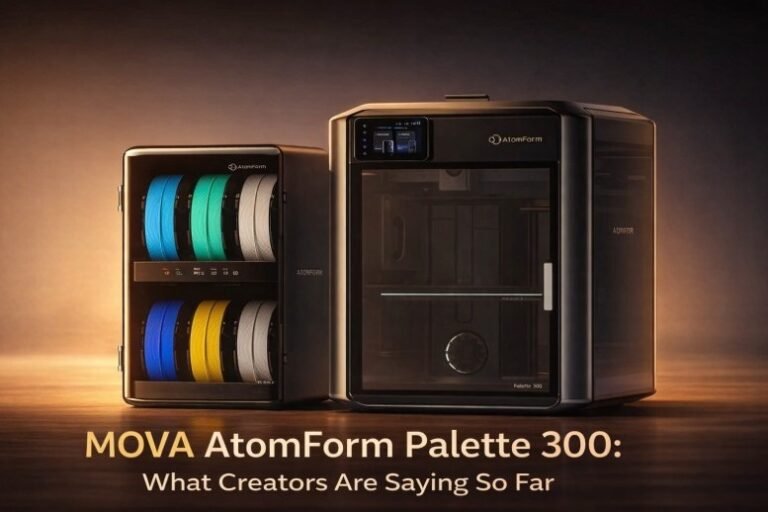
Recently, the 3D printing space has been getting noisy again — not because of faster speeds or bigger build volumes, but because of a machine that’s trying to solve a problem many users have already accepted as “normal.”
That problem is multi-material printing.
The MOVA AtomForm Palette 300 showed up with a very different approach, and naturally, several well-known creators and makers were invited to see it in person. Some focused on the engineering, others just experienced it as a product.
So instead of speculation, this article is based purely on what those creators actually showed and said.
A Familiar Spec Sheet — But That’s Not the Point
On the surface, the Palette 300 doesn’t look unusual. It fits nicely into what we already expect from modern 3D printers.
It comes with:
- 300 × 300 × 300 mm build volume
- CoreXY motion system
- Enclosed chamber (up to around 65°C)
- High-temperature hotend (~350°C)
- Filtration system and multiple cameras
- Touchscreen interface
Nothing here is groundbreaking on its own. In fact, most of this is already standard in higher-end machines today.
But creators didn’t spend much time talking about these specs — because that’s not where this printer stands out.
The Real Focus: Rethinking Multi-Material Printing
What makes this machine different is how it handles color and material changes.
Instead of using a single nozzle and constantly switching filaments (which usually leads to purge waste), the Palette 300 uses a tool-changing system with multiple nozzles.
Inside the machine, there’s a rotating system that can hold up to 12 nozzles. When a print requires a different color or material, the printer doesn’t just swap filament — it physically removes the nozzle and replaces it with another one.
From a creator’s perspective, this felt both familiar and new at the same time. One described it as a “new way of doing an old thing,” because the idea of tightening and loosening nozzles isn’t new — but automating it like this is.
On top of that, there’s another layer to the system that several creators highlighted.
The printer doesn’t wait until the last moment to prepare the next material. Instead, it uses a dual-path feeding system, where the next filament can already be staged and ready. So when the swap happens, it doesn’t need to rewind everything and start again from scratch.
This combination — nozzle swapping plus preloaded filament — is where most of the engineering interest is coming from.
First Impressions: Visually Impressive, Mechanically Interesting
Across different creators, there was a surprisingly consistent reaction: this machine is interesting.
Not just in a marketing sense, but in an engineering sense.
The mechanism itself — with moving parts, rotating systems, and synchronized feeding — is clearly more complex than typical consumer printers. For some creators, that complexity is exactly what makes it exciting.
At the same time, the physical design didn’t raise concerns. Most described it as clean, solid, and well put together, even for what appears to be an early unit.
When it came to print results, the samples shown during the event looked good. Color transitions appeared clean, and there were no obvious defects in the demo prints.
But this is where most creators were careful.
These prints were produced in a controlled environment, likely tuned to showcase the machine’s strengths. So while the results are promising, they are not yet proof of real-world performance.
Where Creators Start to Question Things
Despite the excitement, there are clear areas where creators held back.
The biggest one is reliability.
A system like this introduces a lot of moving parts:
- frequent nozzle changes
- mechanical alignment requirements
- multiple material paths
One creator directly mentioned being curious about long-term durability, while another was only able to get a general answer from the company suggesting a lifespan of a few years under regular use.
At this stage, there’s no independent data to confirm how this system performs over time.
Another concern is software maturity.
From what creators observed, the hardware already looks quite complete. The sensors, cameras, and mechanical systems are all there.
But software is what ties everything together — especially for a system that relies heavily on timing, synchronization, and calibration.
There were hints that the software side is still evolving, and this is something that will only become clear once users start using it outside of demo conditions.
There’s also a more practical question that came up more than once:
Do we actually need 36 colors?
Technically, the system supports it. But even creators who were impressed by the capability admitted they couldn’t immediately think of real use cases for that level of complexity.
It’s a feature that’s impressive on paper, but its practical value is still unclear.
Different Perspectives From Different Creators
What’s interesting is that not all creators walked away with the same conclusion.
Some felt that the machine already looks close to a finished product, especially from a hardware standpoint. The system appeared complete, the UI was functional, and the overall presentation gave confidence.
Others were more cautious, clearly describing it as a beta or early-stage system that still needs validation — particularly in real-world conditions.
There’s also a contrast in how the machine is perceived from a user perspective versus an engineering perspective.
On one hand, the messaging is simple: load your materials, press start, and let the printer handle everything.
On the other hand, what’s happening internally is far from simple. This is a highly complex system, and that complexity doesn’t disappear — it’s just hidden from the user.
So What Do We Know So Far?
Based on all the creator coverage, a few things are clear.
The Palette 300 is not trying to compete by being faster or cheaper. It’s trying to change how multi-material printing works.
There is genuine innovation here, especially in how it reduces waste and prepares materials ahead of time. The engineering direction is different enough to stand out, even to experienced creators.
At the same time, the machine is still unproven.
Not because it looks weak — but because it hasn’t gone through real-world usage yet.
Final Thoughts
Right now, the Palette 300 sits in an interesting position.
It’s not just another iteration of what already exists. It’s a more ambitious attempt to solve a known problem in 3D printing.
Creators are clearly intrigued. Some are excited. But none are fully convinced yet.
And that’s probably the most accurate takeaway for now:
It’s promising — but it still needs to prove itself.
Note:
This article is based on observations and statements from creators who attended the launch event. Domechy has not tested this machine yet. A hands-on review will be needed to fully validate these claims.