


Ridzwan Normahazan
written on 22 May 2026
Bambu Lab X2D After 2 Weeks: Fast, Less Waste, But Who Is It For?
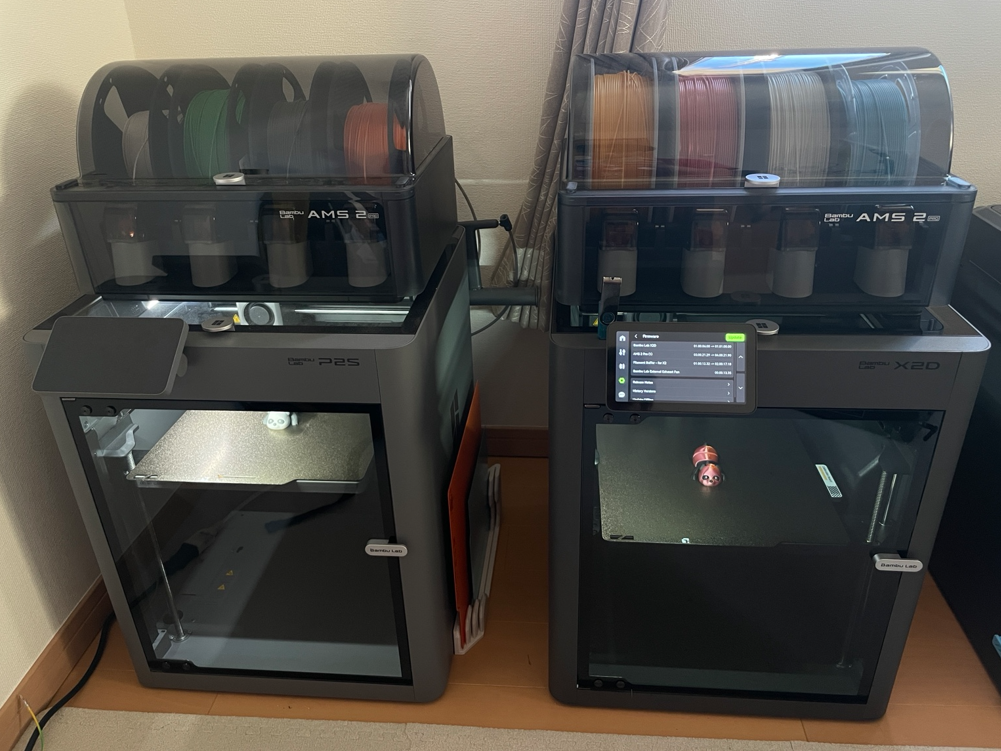
About two weeks ago, I received the Bambu Lab X2D to test and share my thoughts on. Since then, I have been using it regularly for various types of prints, especially multicolor and multi-material prints.
At the same time, I have been receiving many questions from my Facebook followers about the X2D. So in this article, I want to share my early experience after two weeks of use, while answering some of the most frequently asked questions and sharing my thoughts on who this printer is actually for.
My Early Experience with the X2D
Before receiving the X2D, I had been using the Bambu Lab P2S for several months. So I have a clear reference point to compare the two printers.
The first thing I can honestly share, in these two weeks, I have been using the X2D more often than the P2S. Maybe I am a bit biased because it is a new printer, but I genuinely enjoyed using it due to it’s speed and ease of use.
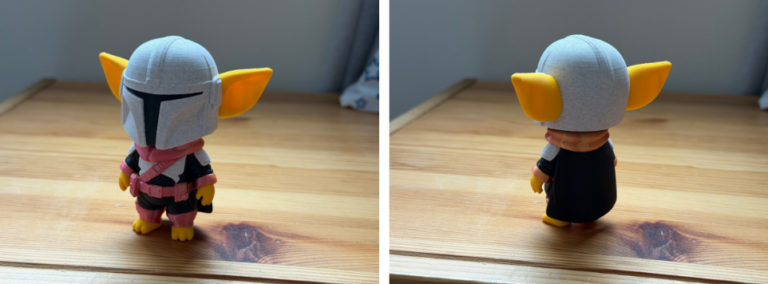
The most noticeable difference between the X2D and P2S is in print time and filament waste, especially when printing a two-color model. For a fair comparison, I printed the same panda model using both printers. I started with two colors to see the maximum difference, then printed with four colors to see what happens when the X2D’s main nozzle needs to produce purge waste like normal.
| Printer | Colors | Print Time | Filament Waste |
|---|---|---|---|
| Bambu Lab X2D | 2 colors | approximately 1h 49m | ~12g (wipe tower only, purge near zero) |
| Bambu Lab P2S | 2 colors | approximately 4h 1m | ~68g (purge + tower) |
| Bambu Lab X2D | 4 colors | approximately 7h 37m | ~107g |
| Bambu Lab P2S | 4 colors | approximately 9h 34m | ~172g |
Waste values are based on slicer estimates. Real-world values may vary slightly. The photos below may also not show 100% of the actual waste as some pieces may have fallen before the photo was taken.
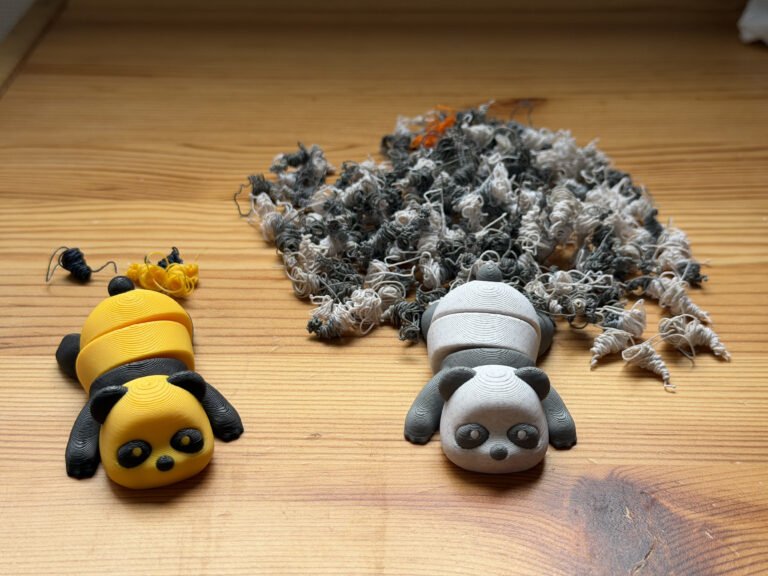
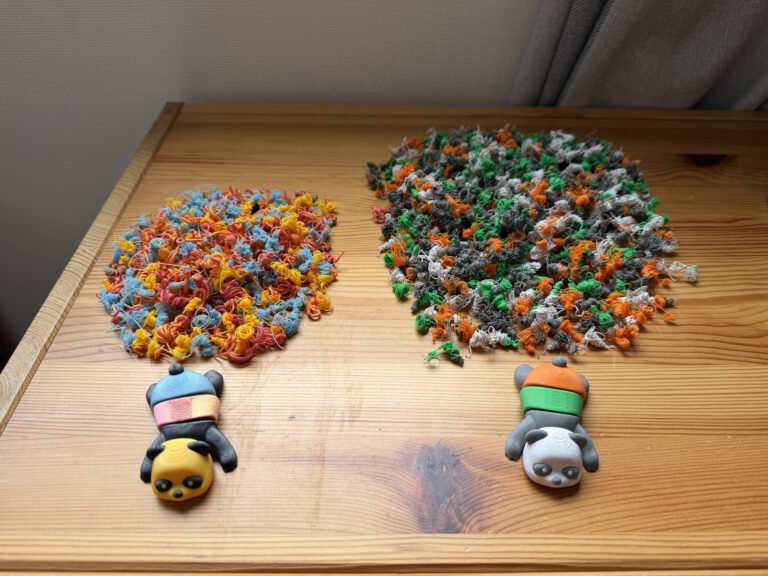
As you can see in the table above, the print time difference is very significant which is more than twice as fast for 2 colors. The X2D’s filament waste is also far less because the dual nozzle system allows for more efficient color changes. For 2 colors, the X2D has almost zero purge waste, except for only a few small purge blobs during the warmup phase.
For 4 colors, the time difference is not as extreme, but the X2D is still faster and produces less waste compared to the P2S.
Minor Issues I Encountered During Testing
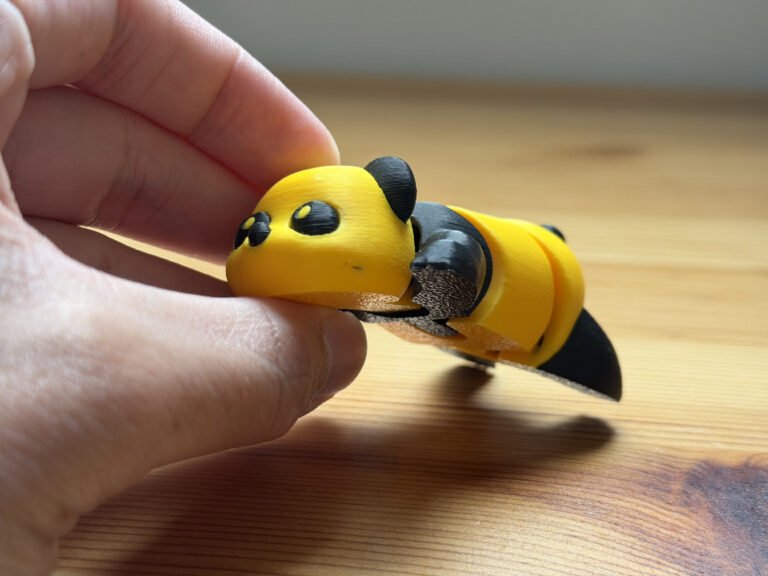
Even though I am really enjoying the Bambu Lab X2D so far, that does not mean everything went smoothly without any issues.
In my very first print, I noticed a small piece of black filament embedded in a section that was supposed to be yellow. It was most likely caused by leftover black filament from the second nozzle sticking during the main nozzle’s yellow print. When I printed a second time, the issue did not repeat. So I consider this a minor isolated incident rather than an ongoing printer problem.
I also tried printing a colorful octopus model. On the first attempt, one of the tentacles did not adhere properly to the print plate and the result was damaged. But the rest of the print looked great. When I tried again, it stuck perfectly and the result was satisfying.
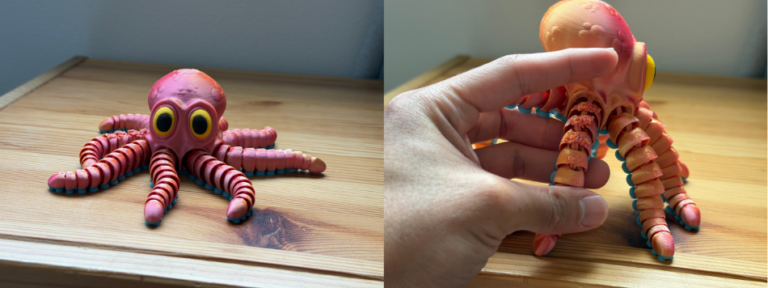
After several other prints, everything produced good quality whether using the main nozzle or the second nozzle. So it is likely that the two failures I experienced were isolated cases. However, that does not mean we should ignore the risk of failure with this printer. Overall, the Bambu Lab X2D is still considered very consistent and capable of producing beautiful prints. But if minor early failures concern you, I would say the Bambu Lab P2S is more consistent in producing prints without issues.
Second Nozzle Performance
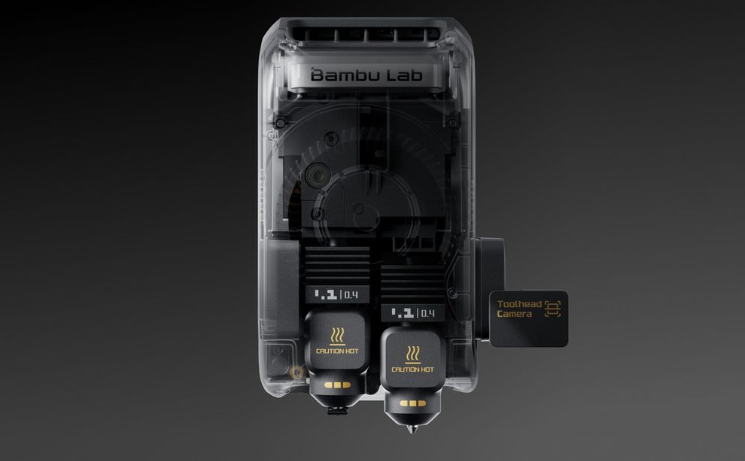
Many people in the community were very skeptical about the X2D’s second nozzle. The reason is that the second nozzle uses a bowden drive system rather than a direct drive like the main nozzle. Bowden drive is typically associated with lower print quality.
But after two weeks of testing myself, I can say that skepticism is not really justified, at least for normal use.
When I placed parts printed by the main nozzle and the second nozzle side by side, I could barely tell the difference between them. And when I compared them further against prints from the P2S, the quality across all three was very close.
Bambu Lab itself advertises the second nozzle more for printing different material supports to make support removal easier and improve overall part quality. But based on my testing, it can also be used for regular printing without a noticeable drop in quality, as long as the use case is not too extreme.
Print Resume After Filament Ran Out
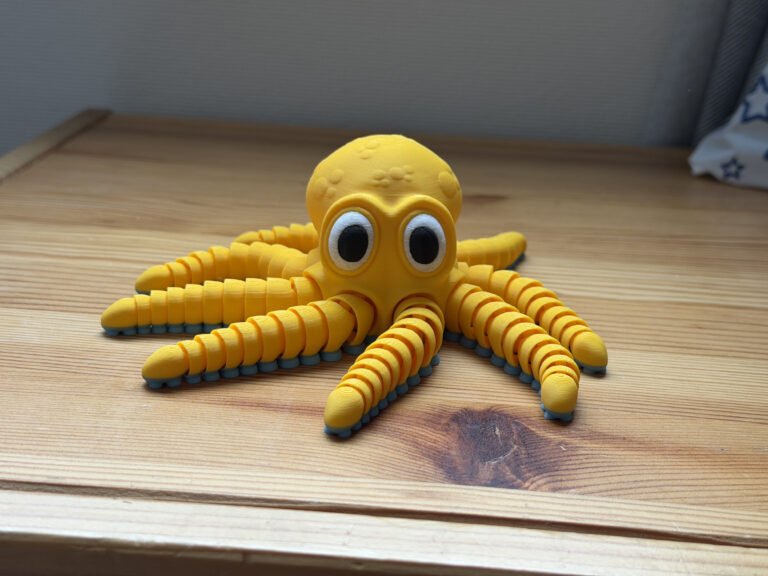
One interesting experience happened while I was printing a more complex multicolor model. Mid-print, one of the filaments ran out and the printer stopped for several hours while I was out. When I came back, I replaced the filament and resumed the print.
I was initially worried there would be a visible layer line from the long pause. But the final result surprised me. The print came out beautifully with no noticeable pause layer.
Q&A About the Bambu Lab X2D
A few weeks ago I opened a question session to my Facebook page followers about the Bambu Lab X2D. Here I will answer those questions.
How much does the X2D cost in Malaysia?
As of this article, the X2D in Malaysia starts at around RM3,499, while the X2D Combo is around RM4,599, depending on the store and current promotions.
X2D or H2C, which is better to get?
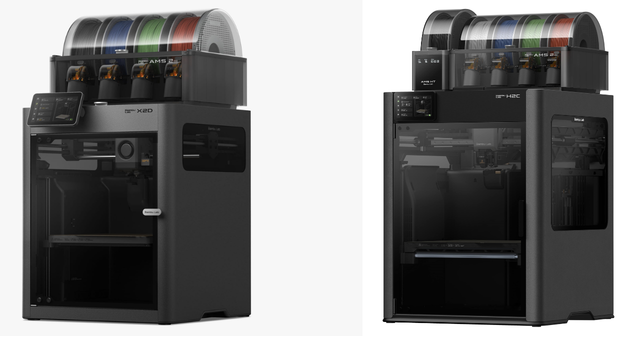
This is a question many people ask, and the answer depends on what you want to print.
The H2C is a higher-class printer at a much higher price which is around USD2,399 or approximately RM11,000. The main difference is the Vortek system in the H2C.
The H2C uses the Vortek Hotend Change System, where the hotend or nozzle itself can be swapped during printing. For certain combinations, this system can reduce or nearly eliminate purge waste compared to a standard AMS system.
The X2D has two fixed nozzles. The main nozzle uses a direct drive system that can change colors through AMS, while the second nozzle is permanently connected to one external filament. Filament waste does occur when changing colors, but it is far less than the P2S.
In short, the H2C is suitable for those who print high volumes of multicolor models and want minimum filament waste. The X2D is more suited for most everyday users who want two-material or two-color prints at a more affordable price.
How does the X2D dual nozzle system work?
The main nozzle of the X2D is a direct drive extruder that works like any standard Bambu Lab printer. It can change filament colors through the AMS for multicolor printing.
The second nozzle is permanently connected to one filament via a bowden tube from outside the printer. This nozzle cannot change filament during printing. The main function Bambu Lab recommends for it is printing different material supports to make removal easier and improve part quality.
But based on my testing, the second nozzle can also be used for regular printing with satisfying quality.
Is the X2D suitable for housewives?
An interesting question and I want to answer it honestly.
In terms of daily use, yes it is easy. Even children can be taught to use it if guided step by step. Bambu Lab does design their printers to be user-friendly.
But my concern is when something goes wrong. Imagine a nozzle clog. For someone without a technical background, would they be confident enough to resolve an issue with the X2D’s more complex nozzle structure compared to a regular printer?
So my answer is, the X2D is suitable for everyday use. But for handling technical issues when they arise, it might be best to have someone knowledgeable on call to help.
X2D or X2D Combo, which should you get?
This depends on what you want to print.
If multicolor printing is not your priority, the X2D without AMS is sufficient. With the dual nozzle system, you can still print up to 2 colors or 2 different materials without AMS. This suits those who mostly print functional parts like robotics accessories, or complex geometry parts that need different material supports.
But if you want to print colorful toys, interesting accessories, or anything involving many colors, I would suggest considering the X2D Combo or even the P2S Combo which is priced lower.
My Initial Thoughts After 2 Weeks
Two weeks with the X2D, and I am genuinely enjoying the experience. The improvement over the P2S is very noticeable especially in terms of print speed and filament efficiency for two-color prints.
There were a few minor incidents early on, but after that the printer has shown consistent and satisfying performance. I have not yet fully tested all its capabilities especially with more challenging materials. Stay tuned for a more in-depth review in a future article.
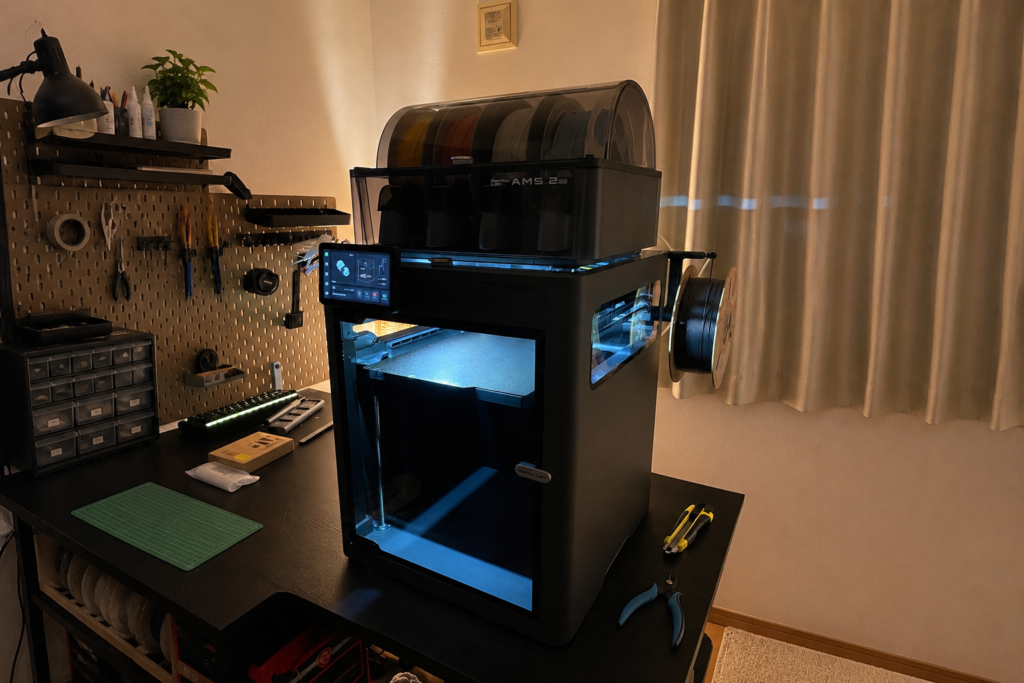
Note: This X2D unit was provided by Bambu Lab for review purposes, but the opinions in this article are based entirely on my own experience.
Looking to buy a 3D printer in Malaysia?
We've put together a curated list of 3D printing shops, filament suppliers, and service providers across Malaysia.
View the directory →Don’t miss the latest articles and guides
Get new Domechy articles, guides and free models straight to your inbox.

Wanna share your thoughts or request anything? Comment below.